
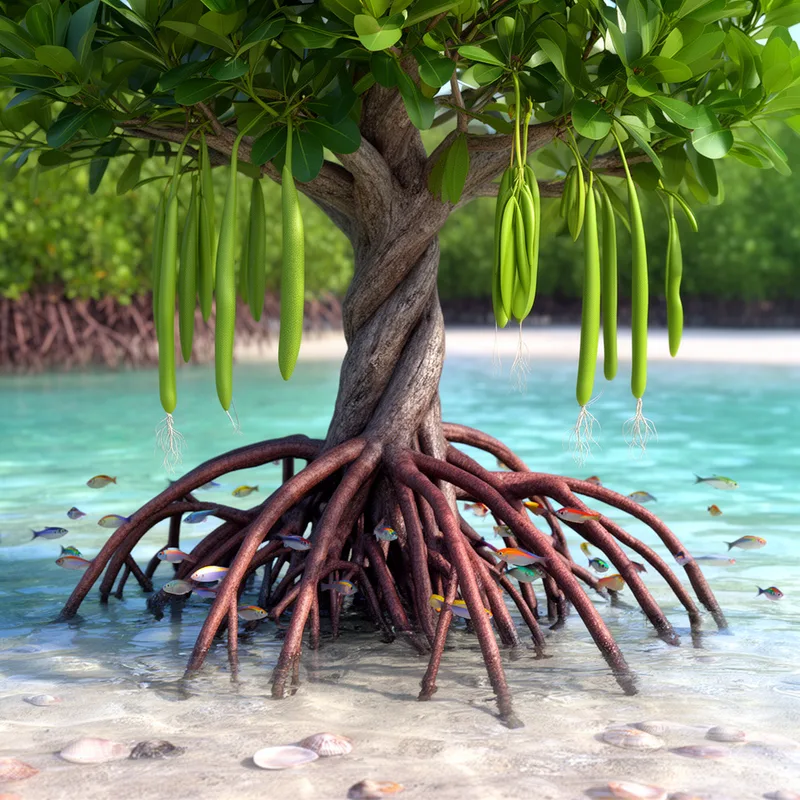
Rhizophora mangle
- noun
- /raɪˈzoʊfərə ˈmæŋɡəl/
- Specialized
- The most widespread and common mangrove in Hawaii is Rhizophora mangle, introduced from Florida to the south shore of Molokai in 1902. Modified from Allen (1998).
Examples
-
Many wildlife species depend on the roots of the Rhizophora mangle for shelter and food.
-
Along the shoreline, the Rhizophora mangle creates a protective barrier against storm surges.
-
The red mangrove, known scientifically as Rhizophora mangle, is essential for stabilizing coastal ecosystems.
Synonyms

 13
7.0
13
7.0

A tropical tree with roots that stick out into the sea and protect the shore
Surface Forms
Morphology
Rhizophora + mangle
This is a Latin binomial (scientific name) for the red mangrove; its meaning as the name of a species is not compositionally derived from the everyday English words. The second element 'mangle' functions as a taxonomic epithet (not the English verb 'mangle'), and taxonomic labels are arbitrary for learners, so the species meaning is not predictable from the parts.
Etymology
Rhizophora mangle may come from old Greek parts rhizo meaning 'root' and phora meaning 'to carry', so the name can be read as 'root-bearer', and the word 'mangle' comes from an old Spanish word for 'mangrove'. That's why the name fits: this red mangrove has many large roots that rise above the water and seem to carry the tree, so the name describes the tree we know today.