

Rhizoctinia solani
- noun
- Specialized
- Black scurf on potatoes is often caused by the fungus Rhizoctinia solani.
Examples
-
The spread of Rhizoctinia solani can significantly reduce potato yields if left untreated.
-
Farmers monitor their crops for signs of Rhizoctinia solani to prevent losses.
-
The crop was affected by Rhizoctinia solani.
-
Farmers must be aware of Rhizoctinia solani to prevent losses.
-
Black scurf on potatoes is often caused by the fungus Rhizoctinia solani.
-
Farmers monitor their crops for signs of Rhizoctinia solani to prevent losses.
-
The spread of Rhizoctinia solani can significantly reduce potato yields if left untreated.
Synonyms
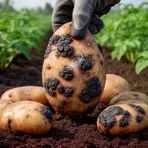
A fungus that causes black scabby spots on potatoes

A fungus that attacks potatoes and makes black spots on the tubers
Surface Forms
Morphology
rhizoctinia + solani
This is a Latin binomial (scientific name) rather than a compositional English phrase: the full meaning (a fungus species causing black scurf on potatoes) is a technical label not predictably built from ordinary English words. One constituent is non‑English/unknown ('solani') and even if a learner knew 'rhizoctinia' = fungus, the species epithet does not transparently convey the disease or host to a B1 learner, so the expression is not derivable from its parts.
Etymology
Rhizoctinia solani may come from words that mean 'root' and 'of the potato', with Rhizo- meaning 'root' and solani meaning 'potato'. The name fits because this fungus lives on potatoes and makes dark, scaly spots called 'black scurf', so it describes what the fungus does.

