
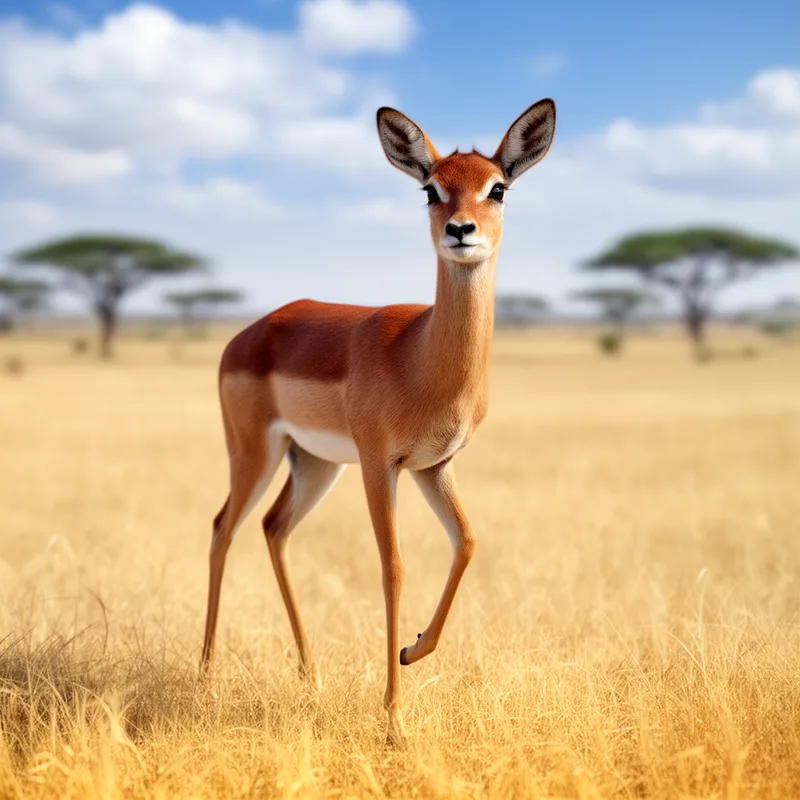
Raphicerus campestris
- noun
- Specialized
- The Raphicerus campestris is often seen grazing alone in the grasslands of southeastern Africa.
Examples
-
Unlike larger antelopes, the Raphicerus campestris relies on camouflage and agility to evade predators.
-
Researchers tracked the movements of several Raphicerus campestris to better understand their habitat preferences.
-
The Raphicerus campestris is a small antelope found in southern Africa.
-
Have you ever seen a Raphicerus campestris in the wild?
-
The Raphicerus campestris has a slender build, making it agile in its natural habitat.
-
Many wildlife enthusiasts travel to southeastern Africa to catch a glimpse of the Raphicerus campestris in the wild.
-
Due to its reddish-brown coat, the Raphicerus campestris blends well into the grassy landscapes of its home.
Synonyms


 1
9.9
A small African antelope with large ears and short horns
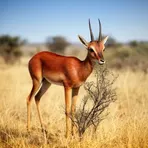
A small, thin African deer-like animal with short horns and reddish-brown fur
Surface Forms
Morphology
Raphicerus + campestris
This is a Linnaean binomial: knowing 'Raphicerus' (a genus of small antelopes) lets a learner infer the referent is a species of that antelope, so the general category is predictable. However, the species epithet 'campestris' is a Latin modifier (no dictionary gloss provided) and does not yield the common name 'steenbok' or the full specific sense, so the exact meaning is not fully derivable from the parts.
Etymology
Raphicerus campestris may come from old Latin words: the first part Raphicerus is the group name and campestris means 'of the fields'. The name paints a clear image of a small antelope living in open grass, which is exactly what this species is.