
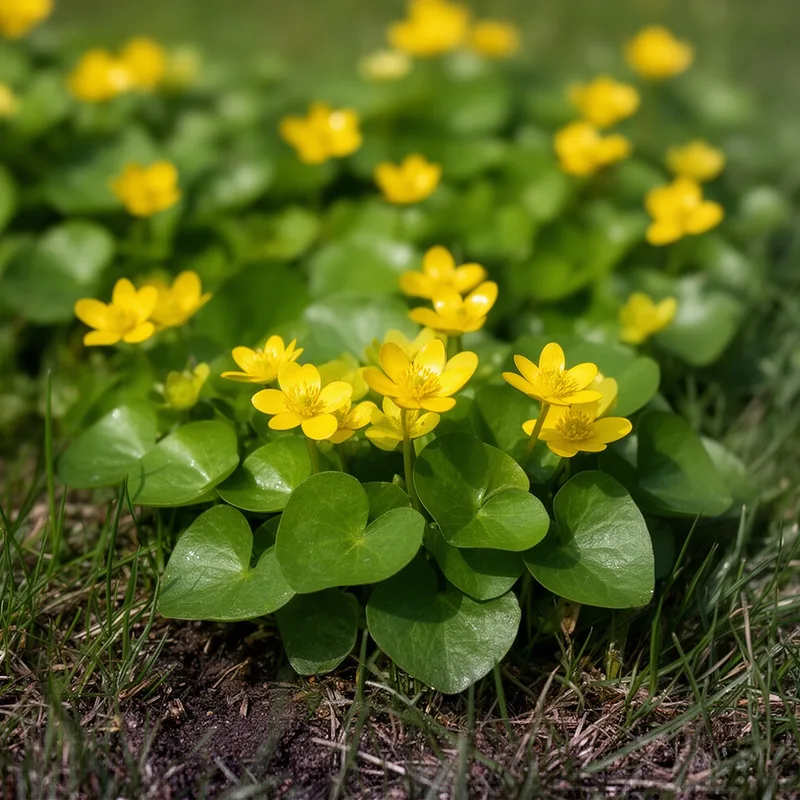
Ranunculus ficaria
- noun
- /ræˈnʌŋkjələs fɪˈkɛəriə/
- Specialized
- Ranunculus ficaria typically blooms in early spring with a striking carpet of yellow flowers.
Examples
-
The roots of Ranunculus ficaria were traditionally used in folk medicine to treat piles.
-
Gardeners sometimes struggle to control the rapid spread of Ranunculus ficaria in moist lawns.
-
Look at the beautiful Ranunculus ficaria flowers blooming!
-
The Ranunculus ficaria blooms in early spring.
-
In spring, Ranunculus ficaria transforms gardens with its vibrant yellow flowers.
-
The roots of Ranunculus ficaria have long been used in traditional remedies for piles.
-
Many people enjoy the sight of Ranunculus ficaria spreading across their lawns in April.
Synonyms

A small plant with heart-shaped leaves and bright yellow flowers like a buttercup
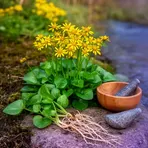
European wild plant with bright yellow flowers and heart-shaped leaves whose roots are used to treat piles or hemorrhoids
Surface Forms
Morphology
Ranunculus + ficaria
This is a scientific binomial (genus + species) so a learner who knows 'Ranunculus' can reasonably infer that Ranunculus ficaria is a type of Ranunculus (i.e., a plant species). However, the species epithet 'ficaria' has no clear English meaning and does not convey the specific traits (lesser celandine, tuberous roots, medicinal use), so the full descriptive meaning is not predictable from the parts.
Etymology
Ranunculus ficaria may come from Latin words: ranunculus meaning 'little frog' because the plant often grows in wet places, and ficaria meaning 'fig-like' for its small tuber roots. So the name creates a clear picture of a small yellow flower with 'fig-like' roots, which helps explain why people once used the roots in folk medicine to treat piles.

