
Raffia taedigera
- noun
- Specialized
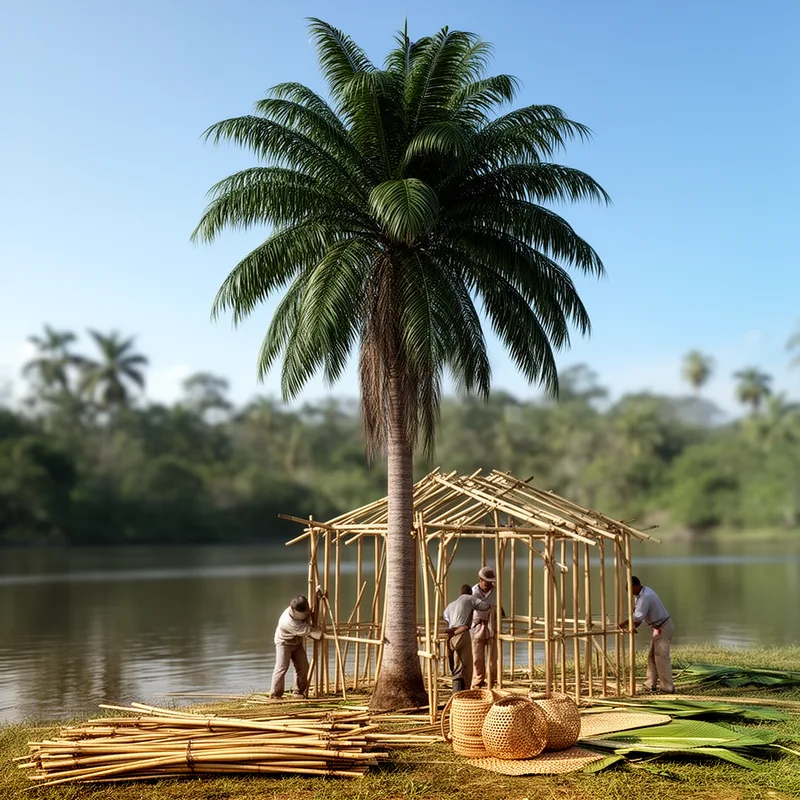
- Local builders sometimes use the strong stems of Raffia taedigera for constructing frameworks.
Examples
-
The leaves of the Raffia taedigera are often used to make baskets and mats.
-
Researchers studied the habitat of Raffia taedigera along the riverbanks in Brazil.
-
The Raffia taedigera is often found in tropical regions.
-
Many artisans use Raffia taedigera for crafting baskets.
-
Local builders sometimes use the strong stems of Raffia taedigera for constructing frameworks.
-
Many artisans use Raffia taedigera to create durable baskets and mats.
-
In Brazil, the tall Raffia taedigera is known for its large, feather-like leaves.
Synonyms

 46
1.0
46
1.0

A tall tree with one straight trunk and big leaves at the top

 1
8.3
1
8.3
A palm tree with long leaves people use to make strong fibers for baskets and mats

A tall palm tree from Brazil with very large split leaves and strong stems used for building or weaving

A tall Brazilian palm tree with very large tough leaves whose strong stems are used for building

A tall palm from Brazil with very large feather-like leaves and strong stems used for building

A tall tropical palm tree with strong fibrous leaves grown for weaving
A palm tree with long leaves divided into many thin parts like a bird's wing
Surface Forms
Morphology
raffia + taedigera
This is a Latin binomial species name: 'raffia' is an English noun for a type of palm fiber, but 'taedigera' is not an English word and the combination functions as a taxonomic label rather than a compositional phrase. A B1 learner who knows 'raffia' would not be able to derive the specific botanical meaning or geographic information from the unknown epithet, so the expression is not transparently interpretable.
Etymology
Raffia taedigera gets its name from Raffia — the long, strong fibers taken from the palm's leaf stems — and taedigera as the species name. Picture long, ribbon-like stems used to tie roofs and weave baskets; that image shows why this tall 'palm' is known for its strong 'stems' used in building and weaving.