

ROM
 31
5.2
31
5.2

- noun
- /rɒm/
- Specialized
- Unlike RAM, ROM retains its data even when the device is turned off.
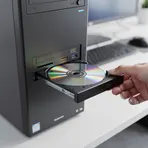
- CD-ROM
- ROM drive
- ROM disc
Loading YouTube…
Watch on YouTubeAs it turns out, one of our ROM chips is just broken.
- As it turns out, one of our ROM chips is just broken.
Examples
-
The market favored CD-ROM because of its larger flexibility and better integration with existing computer systems.
Academic text (2015) -
With a scanner and a CD-ROM, I could produce braille versions of all sorts of print material.
Academic text (1996) -
So our completed control ROM for the bit clear operation is shown here.
-
As it turns out, one of our ROM chips is just broken.
-
So our completed control ROM for the STR operation is shown here.
-
The advantages of using CD-ROM are both storage capacity and speed.
Academic text (1992) -
Next to that we've got the the ROM, which has got Microsoft BASIC burned onto it.
-
It also had a 32-kilobyte ROM.
-
The librarian teaches them how to use CD-ROMs and other forms of research they have ignored for years.
Academic text (1994) -
IBM-compatible with 500 meg hard drives, CD-ROM and 14.4 modems.
Synonyms


 1
4.4
1
4.4
A small computer chip that holds information you can use but cannot change

A part of a computer where information can be looked at but not changed

A small computer chip that stores data you cannot change

Computer memory you can read but cannot change
Compounds

How Writable

Surface Forms
Morphology
ROM = memory + read-only (semi-transparent) = R + O + M
The letter sequence ROM is a direct initialism of 'read-only memory', so the relation to the expansion is clear for learners who know the phrase. [Postprocessing: changed transparency from 'transparent' to 'semi-transparent' for abbreviation]
Etymology
ROM comes from the phrase read-only memory, where read means 'to look at data', only means 'not changeable', and memory means 'where data is stored'. So ROM is a part of a computer you can read but not change, and it keeps its data when the power is off.