
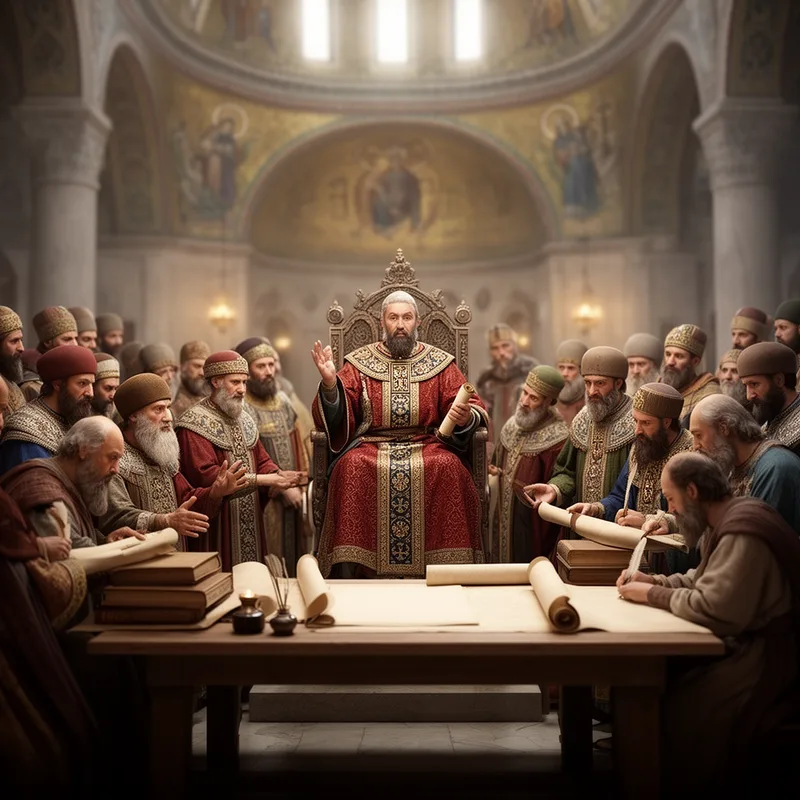
Quinisext Council
- noun
- /ˈkwɪnɪˌsɛkst ˈkaʊnsl/
- The Quinisext Council established many rules that shaped the Eastern Orthodox Church.
Examples
-
The canons from the Quinisext Council are still referenced in some religious traditions today.
-
In 692 AD, the Quinisext Council took place in Constantinople.
-
Historians often study the Quinisext Council to understand early church law.
-
The Quinisext Council was a pivotal moment in church history.
-
The Quinisext Council established many rules that shaped the Eastern Orthodox Church.
-
Historians often study the Quinisext Council to understand early church law.
-
The canons from the Quinisext Council are still referenced in some religious traditions today.
Surface Forms
Morphology
Quinisext + council
The noun 'council' clearly signals an assembly or ecclesiastical meeting, so a learner who knows that word will understand this is a specific council. However, 'Quinisext' is a language-specific proper name with no transparent lexical meaning for learners, so the precise historical sense (an ecumenical council in 692 establishing canons) is not derivable from the parts. Because the type is transparent but the identifying name and detailed meaning are not, this is partially but not fully transparent to a B1 learner.
Etymology
Quinisext Council gets its name from old words for 'five' and 'six', with quini meaning 'five' and sext meaning 'six', because this one meeting acted like both the fifth and the sixth church councils and made many rules. So the Quinisext Council refers to the special 692 church meeting that set important rules.

