

Quercus robur
- noun
- Specialized
- The majestic Quercus robur dominates many ancient English woodlands.
Examples
-
Scientists studied the leaf shape of Quercus robur to understand its adaptability to climate change.
-
Carpenters often use timber from Quercus robur for making durable furniture.
-
The Quercus robur is often found in parks and gardens.
-
Many people appreciate the Quercus robur for its sturdy wood.
-
Carpenters often use timber from Quercus robur to create strong and durable furniture.
-
The majestic Quercus robur, known for its iconic lobed leaves, can be seen in many ancient English woodlands.
-
Many people value Quercus robur for its light-colored wood, which is ideal for building and crafting.
Synonyms

A large tree from Europe with rounded leaves and strong light-coloured wood
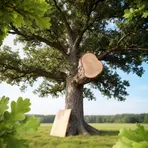
A large tree with strong light-coloured wood and leaves with rounded edges

A large European tree with leaves that have rounded lobes and strong light-colored wood used for building
How Big


Surface Forms
Morphology
Quercus + robur
This is a Latin binomial (scientific) name rather than an English compositional phrase; its meaning 'English oak' is not transparently built from English constituent words, and the second element 'robur' is not an English word. Even if a learner recognizes Quercus as the oak genus, the species epithet gives no predictable meaning to a B1 learner, so the term is domain-specific and not inferable from its parts.
Etymology
Quercus robur comes from Latin words: Quercus meant 'oak' and robur meant 'strength' or strong wood. Because people used this very hard wood for building and furniture, the name points to the tree we call the 'English oak' today.