
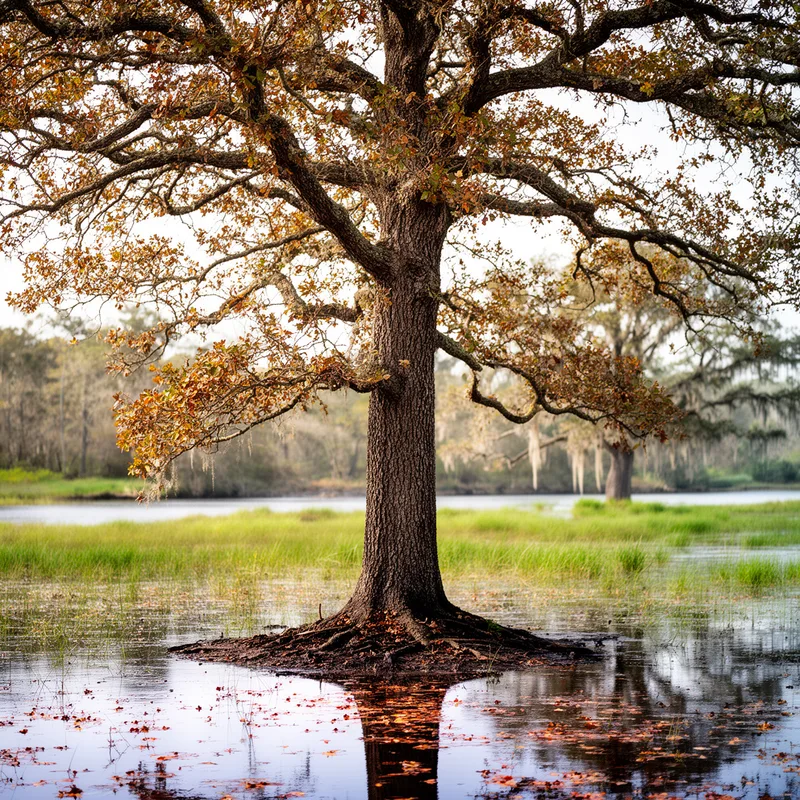
Quercus lyrata
- noun
- /ˈkwɜrkəs lɪˈrɑːtə/
- Specialized
- Botanists studied the unique acorn structure of Quercus lyrata to understand its adaptation.
Examples
-
Because of its tolerance to wet soils, Quercus lyrata is planted for erosion control near rivers.
-
The Quercus lyrata is often found in lowland forests and floodplains in the southern United States.
-
The Quercus lyrata is commonly found in wetlands.
-
Many birds nest in the branches of the Quercus lyrata.
-
The Quercus lyrata, also known as the overcup oak, is a vital part of the ecosystem in the wetlands of the southern United States.
-
Due to its unique acorns, which mature quickly, the Quercus lyrata provides essential food for wildlife.
-
In areas prone to flooding, the resilient Quercus lyrata thrives by stabilizing the soil with its extensive root system.
Synonyms

A medium to large tree that loses its leaves and has acorns deeply covered by their cup
Surface Forms
Morphology
Quercus + lyrata
The binomial form Quercus lyrata transparently signals a species within the oak genus because 'Quercus' = oak, so a learner who knows the constituents would infer it is a type of oak. However, the specific species sense (overcup oak, deeply enclosed acorns, wetland habitat) is encoded in a Latin epithet ('lyrata') that is not a productive English morpheme, so the detailed meaning cannot be derived from the parts.
Etymology
Quercus lyrata is a Latin name: Quercus means 'oak' and lyrata means 'lyre-shaped', a shape like a small harp, so the name points to the tree's curved leaves. It is also called the 'overcup oak' because the cup covers most of the acorn, and that image of an acorn almost hidden by its cup helps you remember the tree and its home in wet places.

