
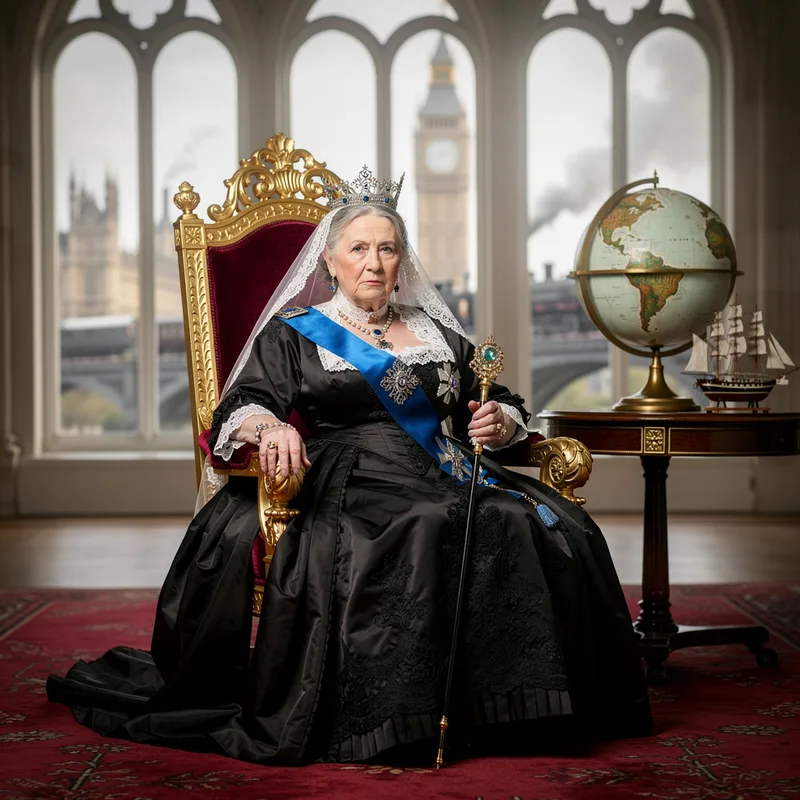
Queen Victoria
 5
3.5
5
3.5

- proper noun
- /kwin vɪkˈtɔːrɪə/
- In 1876, Queen Victoria was proclaimed Empress of India, reflecting her vast imperial authority.
Examples
-
Queen Victoria ruled the Queen Victoria United Kingdom from 1837 to 1901, marking a significant period in British history.
-
On August 15, 1858, Queen Victoria sent a telegram to President Buchanan.
Academic text (2011) -
This was once Queen Victoria's room.
-
And he will most certainly send a glowing report to Queen Victoria.
-
Queen Victoria ascended the British throne at the age of seventeen.
Fiction book (1999) -
Queen Victoria helped alter that state of affairs by resolving in 1876 that she be formally proclaimed Empress of India.
Academic text (1997) -
Dressed in an Eton collar and black coat, Chandler joined Dulwich College as a day boy in September 1900, the penultimate year of Queen Victoria's sixty-four-year reign, at the age of twelve.
Fiction book (1999) -
During her reign, Queen Victoria's influence expanded the British Empire, making her one of the most significant monarchs of the era.
Synonyms
 62
3.4
62
3.4
Queen of Britain from 1837 to 1901
Surface Forms
Morphology
The phrase is directly compositional: the noun 'queen' (a royal title) combined with the proper name 'Victoria' denotes the monarch named Victoria. A B1 learner who knows both constituents will immediately grasp it refers to the queen called Victoria (though detailed historical facts about her reign require extra knowledge); title+name constructions are cross-linguistically common and therefore transparent.
Etymology
Queen Victoria became queen in 1837 and ruled for over 63 years, so she came to represent her whole time. Because of that, people named the period and its style the 'Victorian' era today.