
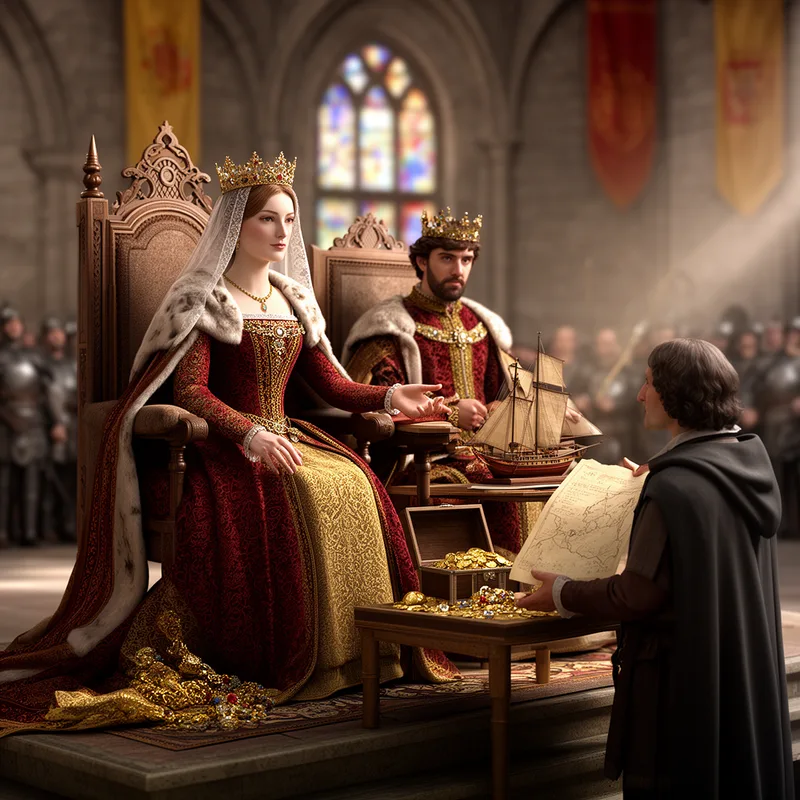
Queen Isabella
 2
6.2

- proper noun
- Queen Isabella supported Christopher Columbus's voyages, which ultimately led to the discovery of the Americas.
Examples
-
Before his first voyage, Columbus had been summoned to the royal camp at Santa Fe, from which King Ferdinand and Queen Isabella were directing the siege of Grenada, the last Moorish stronghold in Spain.
Academic text (1992) -
Fuson points out that the "holograph original" has not been seen since the death of Queen Isabella in 1504, and it is only presumed to have been in her possession up until that time.
Academic text (1992) -
The original log was presented to Queen Isabella: "With very little delay, she commanded a scribe to prepare an exact copy for the Admiral."
Academic text (1992) -
In 1492, Queen Isabella and King Ferdinand united their kingdoms, paving the way for a unified Spain.
-
Queen Isabella is remembered for her role in establishing the Spanish Inquisition during her reign.
Synonyms


 1
9.0
Queen of Castile who married Ferdinand, helped unite Spain, set up the Spanish Inquisition, and funded Columbus's 1492 voyage
 1
8.8
A queen of Castile who helped unite Spain and paid for Columbus's voyages
Queen of Castile who helped unite Spain and paid for Columbus's voyages
Surface Forms
Morphology
queen + Isabella
A learner who knows 'queen' and recognizes 'Isabella' as a proper name can transparently infer this refers to a female monarch called Isabella, so part of the meaning is immediately recoverable. However, the specific historical identity and details (queen of Castile, dates, role in unification, Inquisition, Columbus) cannot be derived from the constituents alone and require extra world knowledge, so the expression is only partially predictable.
Etymology
Queen Isabella refers to the queen of Castile who married Ferdinand and helped bring the different kingdoms together to form what became Spain. She also paid for Columbus's 1492 voyage and started the Spanish Inquisition, so Queen Isabella today means the powerful queen who changed Spain's history.