
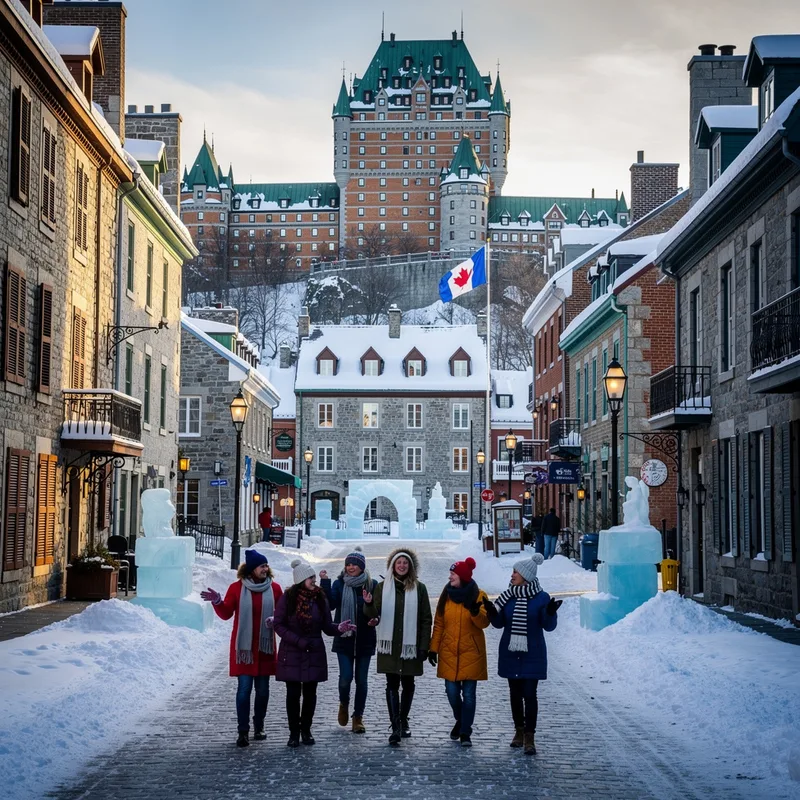
Quebec City
 3
1.8
3
1.8

- proper noun
- /kwɪˈbɛk ˈsɪti/
- The many Ontarians and Americans who annually come by automobile to Quebec City bypass Victoriaville, 15 kilometers off the main highway.
- Irish in Quebec City
Examples
-
Colleagues know him as the Count of Mont Ste.-Anne, the skiing village near Quebec City where he owns a chalet.
Academic text (1997) -
My favorite port was Quebec City because of the diversity of the people and their friendly energy.
Academic text (2006) -
In Quebec City, he was expected to work two and a half hours longer.
Academic text (2008) -
My mother once took the bus to Quebec City.
Fiction book (1994) -
Our village was 60 miles south of Quebec City, next to the U.S. border and Maine.
Fiction book (1994) -
Temperatures tomorrow in Quebec City will be in the low fifties.
Fiction book (1995) -
The population of Quebec City, contrary to that of most other Canadian cities in the nineteenth century, was mostly Catholic.
Academic text (2003) -
The occupational structure of the Irish in Quebec City in the mid-nineteenth century may serve to test this assertion.
Academic text (2003) -
The capital of Quebec province, Quebec City is known for its historic architecture and vibrant French-speaking community.
-
Many tourists flock to Quebec City to explore its charming streets and enjoy French cuisine.
Synonyms
 4
2.4
4
2.4
A capital city of the province where many people speak French on the Saint Lawrence River
Surface Forms
Morphology
The meaning is directly compositional: 'Quebec' (the place name) combined with 'city' yields the city named Quebec, i.e. the provincial capital. This 'X City' naming pattern is transparent and cross-linguistically common, so a B1 learner who knows both constituents would understand the MWE.
Etymology
Quebec City: The name Quebec, once said as 'kebec', comes from an old Indigenous word meaning 'where the river narrows'. Imagine the Saint Lawrence River getting narrow at that spot so people met, traded and built a town, and that is why the place kept the name 'Quebec City' today.