
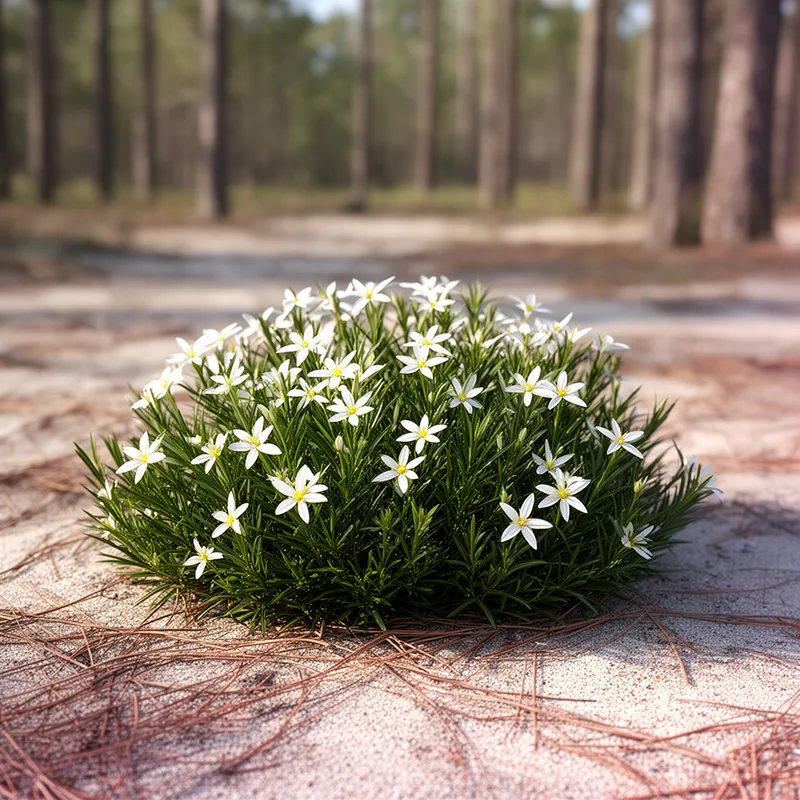
Pyxidanthera barbulata
- noun
- Specialized
- The Pyxidanthera barbulata thrives in sandy soils.
Examples
-
Botanists are studying how Pyxidanthera barbulata adapts to the unique soil of the New Jersey pine barrens.
-
Many gardeners love Pyxidanthera barbulata for its star-shaped flowers.
-
Pyxidanthera barbulata can be found blooming in the sandy pine barrens in early spring.
-
The delicate flowers of Pyxidanthera barbulata are a sure sign that the season is changing.
-
Pyxidanthera barbulata is often seen carpeting the forest floor with its lush green leaves and white flowers.
-
Pyxidanthera barbulata displays its beautiful star-shaped flowers in the springtime, attracting many pollinators.
-
Pyxidanthera barbulata grows well in the pine barrens, benefiting from the well-drained sandy soil.
Synonyms
 1
9.5
1
9.5

A low evergreen bush with narrow leaves and small white flowers

 1
9.9
1
9.9
A low evergreen bush with small white star-shaped flowers that grows in sandy pine woods

A low evergreen plant with small overlapping leaves and white star-shaped flowers
Surface Forms
Morphology
Pyxidanthera + barbulata
This is a Linnaean binomial composed of a genus name and a species epithet: knowing 'Pyxidanthera' as a genus of low shrubs lets a learner infer it is a type of shrub, but the species element 'barbulata' is a Latin/formal epithet not transparently meaningful to a B1 learner. The full descriptive meaning (creeping evergreen with narrow overlapping leaves and white flowers) cannot be derived from the constituents, so the expression is only partially transparent.
Etymology
Pyxidanthera barbulata gets its name from old Greek and Latin words that describe its flowers: pyxid- suggests a small 'box' and -anthera means the part that holds the pollen, while barbulata means a little 'beard' for tiny hairs. So the name helps you picture the plant's small box-like pollen parts and tiny hairs, which is why botanists use it today.