
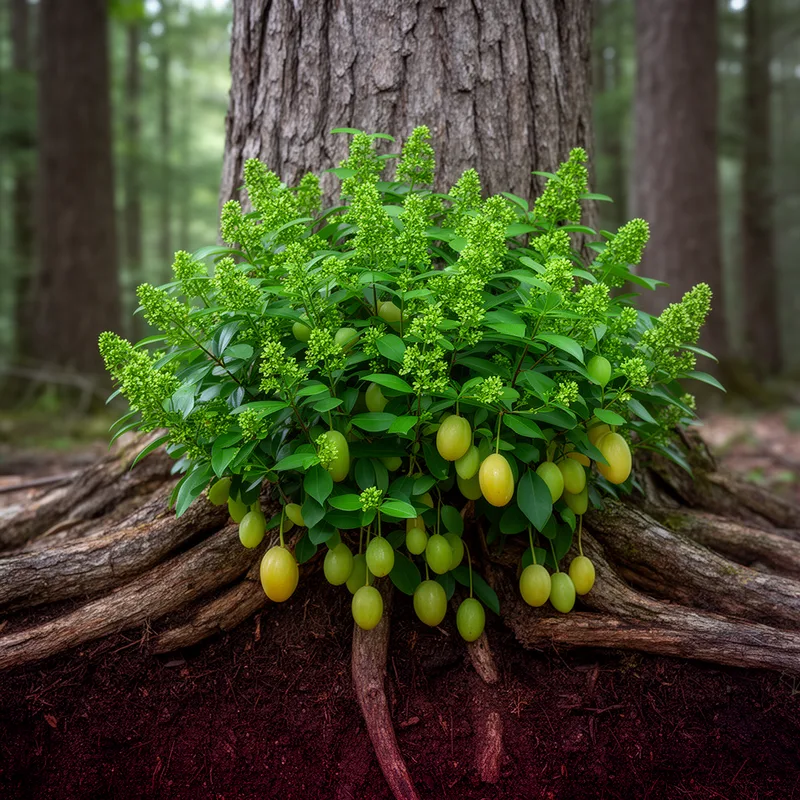
Pyrularia pubera
- noun
- Specialized
- Botanists studied how Pyrularia pubera parasitizes the roots of its host trees.
Examples
-
The drupes of Pyrularia pubera are a distinguishing feature of the plant.
-
Pyrularia pubera can often be found growing near hemlock trees in the Appalachian region.
-
The Pyrularia pubera thrives in moist, shaded areas.
-
Have you ever seen a Pyrularia pubera in the wild?
-
In the southeastern United States, Pyrularia pubera typically grows in association with hemlock trees.
-
Researchers observed that Pyrularia pubera extracts nutrients by parasitizing the roots of its host.
-
The pulpy drupes of Pyrularia pubera are often sought after by wildlife in its native habitat.
Synonyms

A small bush that takes food from hemlock tree roots and has pale flower spikes and soft fruit

A shrub that attaches to hemlock roots and has small green flowers and soft fruits
Surface Forms
Morphology
Pyrularia + pubera
This is a taxonomic Latin binomial combining a genus name (Pyrularia) with a species epithet; if a learner knew both constituents they could infer it denotes a particular species of Pyrularia (partial compositionality). However, the specific botanical attributes given in the definition (parasitic on hemlocks, flower and fruit details) are not derivable from the parts, and species epithets are often opaque or unfamiliar to B1 learners, so the overall predictability is limited.
Etymology
Pyrularia pubera probably comes from Latin words that describe the plant: pyrularia from 'pyrus' meaning 'pear' for its soft, pear-like fruit, and pubera from 'puber' meaning 'hairy' for its fuzzy stems or fruit. That's why the name points to a shrub with pulpy fruit that is often a little hairy.

