

Pulicaria
- noun
- Specialized
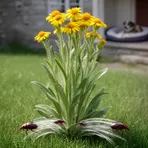
- The genus Pulicaria includes several herbs known for their bright yellow flowers.
- D. pulicaria
Examples
-
In gardens, Pulicaria attracts pollinators with its vibrant blooms.
-
Traditional medicine uses Pulicaria for its potential herbal properties.
-
The result involving D. pulicaria seems surprising at first.
Academic text (2010) -
Furthermore, we previously found that higher relative and absolute abundance of D. pulicaria corresponds with smaller epidemics on two time scales:
Academic text (2010) -
Large epidemics most commonly erupt in systems with a proportionally higher density of the congeneric species D. pulicaria.
Academic text (2010) -
Between lake years and within a season, higher relative and absolute density of D. pulicaria correlated with decreasing infection prevalence (Hall et al. 2009b).
Academic text (2010)
Synonyms

A small daisy-like plant with yellow or white flowers often seen as a weed
Compounds
- Specialized
A hairy perennial herb with yellow daisy-like flowers from Europe used to repel fleas
Surface Forms
Etymology
Pulicaria comes from the Latin root pulic-, which means 'flea' and is like the English word 'flea'. The plants were called fleabane because people used them to keep fleas and other insects away, so Pulicaria today is a group of daisy-like herbs often used as insect repellent.

