
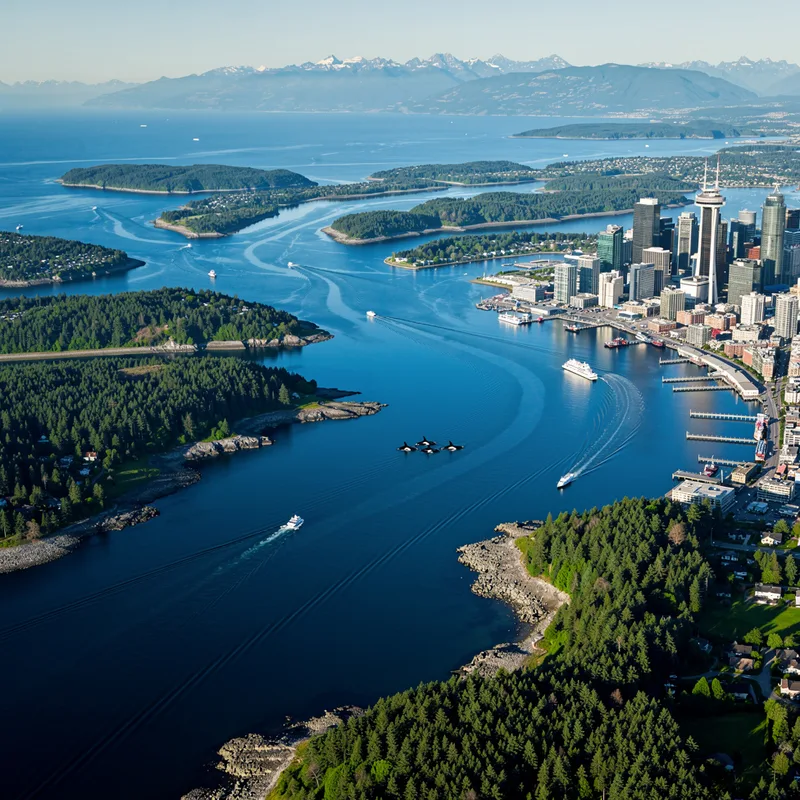
Puget Sound
 3
4.0
3
4.0

- proper noun
- /ˈpjuːdʒɪt saʊnd/
- In Washington, salmon farms are located within Puget Sound, an area widely used and enjoyed by residents.
Examples
-
When Beth and I were young, we stayed at an inn on Puget Sound.
Fiction book (1992) -
Jim devotes countless hours of service to PSA and the Puget Sound Chapter as a board member.
Academic text (1995) -
When he reached Puget Sound, he liked it so well that he decided to go no further.
Fiction book (2000) -
Reason lived on an island in the Puget Sound, between Old Canada and what had once been the United States.
Fiction book (1991) -
When the Navy called, I was on Puget Sound, watching otters.
Fiction book (1992) -
To the good people of Seattle, ninety miles south up Puget Sound, Seattle made the most sense.
Fiction book (1991) -
We'd sailed to Puget Sound, and in Seattle we almost put to port.
Fiction book (1996) -
PHOTO (COLOR): Tribes of the Puget Sound are famous for their beautiful totem poles.
Fiction book (2000) -
But the significance of the case for salmon restoration, not only in the case area of the Puget Sound basin but throughout the Pacific Northwest, should not be underestimated.
Academic text (2017) -
The picturesque views of the sailboats gliding across Puget Sound are breathtaking.
Surface Forms
Morphology
Puget + sound
Although 'Puget' is a proper name and not semantically meaningful on its own, the noun 'sound' denotes a narrow inlet or body of water, so a B1 learner who knows 'sound' can infer this is a geographic inlet called Puget. Proper-name + geographic-term constructions are cross-linguistically common and follow a transparent compositional pattern, even if learners would not know the exact location or specific features without additional knowledge.
Etymology
Puget Sound gets its name from the British explorer George Vancouver, who in 1792 named the water after his officer Peter Puget. The word Sound means a big area of sea or an 'inlet' between land and islands, so the name shows it is a large inlet of the ocean.