

Puck
 46
9.9
46
9.9

- noun
- /pʌk/
- Literature
- Oberon's orders to Puck seem to enjoin the creation of an asymmetry rather than a balance.
- Puck and Oberon
Examples
-
This is my friend Puck.
-
Not even Puck could dance like that!
Fiction book (1992) -
I'm on my way to meet Peter Hall for an audition for Puck in A Midsummer Night's Dream, and I'm late.
-
DRAWING: Puck mocks humanity in Shakespeare's A Midsummer Night's Dream.
Academic text (1991) -
"A sweet Athenian lady is in love with a disdainful youth," Oberon tells Puck: "Anoint his eyes," so that "he may prove more fond of her than she upon her love."
Academic text (1998) -
Oberon commands the impressive talents of Puck; Titania, the merely decorative attentions of her miniaturized fairy attendants.
Academic text (1998) -
From their strife, and from Puck's trickery and Bottom's credulity, grows a work all the more constant for its ludicrous mismatches and confusion.
Academic text (1998) -
In Shakespeare's play, Puck is known for causing chaos and confusion among the lovers.
-
Puck played tricks on the characters in the forest, delighting in their misfortune.
-
The mischievous fairy Puck transformed himself into various shapes to entertain the audience.
Synonyms


 1
9.9
1
9.9
A small mischievous spirit that plays tricks on people at night
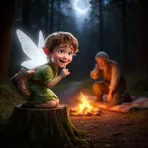
A playful fairy in old stories who hides things and plays tricks on people
Compounds

- UK
4
2.8
A flat round piece of hard rubber that players use instead of a ball in ice hockey

- Jargon
Shooting the puck from your defensive zone past the center and opponent goal line without it being touched, stopping play
Surface Forms
Etymology
Puck comes from an old English word puca meaning 'goblin' or 'spirit', and it is related to the Irish púca, a trickster creature. That's why Shakespeare's Puck is a mischievous sprite who plays pranks, and why a playful person can be called 'puckish' or like an 'imp'.