
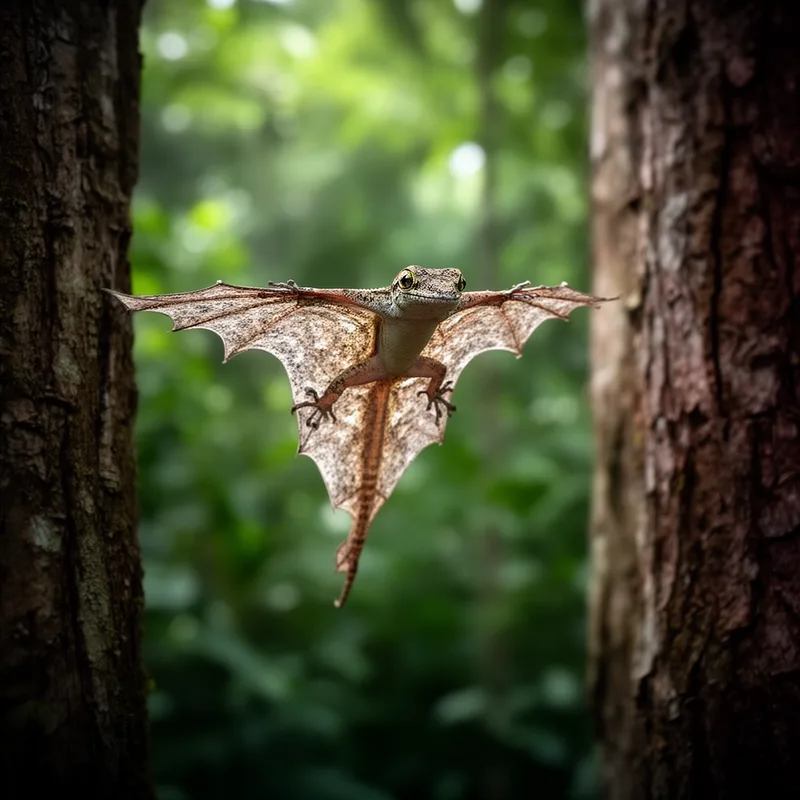
Ptychozoon homalocephalum
- noun
- Specialized
- The Ptychozoon homalocephalum can glide from tree to tree using the flaps along its sides.
Examples
-
The Ptychozoon homalocephalum can glide between trees.
-
The Ptychozoon homalocephalum uses its unique skin flaps to glide from branch to branch in the forest.
-
Anatomical adaptations allow Ptychozoon homalocephalum to cover surprising distances for a lizard.
-
Researchers observed the Ptychozoon homalocephalum in its natural Southeast Asian habitat.
-
Have you ever seen a Ptychozoon homalocephalum in the wild?
-
You can often spot the Ptychozoon homalocephalum as it glides gracefully through the trees of its tropical habitat.
-
In the wild, the Ptychozoon homalocephalum effortlessly glides across short distances to escape predators.
Synonyms

A small lizard with skin flaps on its sides, legs, and tail that let it glide short distances

A small lizard with skin flaps on its sides, legs, and tail that glides short distances between trees
Surface Forms
Morphology
Ptychozoon + homalocephalum
This is a scientific Latin binomial (a species name) functioning as a proper noun rather than a compositional English phrase; a B1 learner would not be able to derive its specific meaning because the second element 'homalocephalum' is unknown and the name does not follow ordinary English composition patterns. Even if 'Ptychozoon' signals a gliding gecko, the binomial as a whole is a taxonomic label and therefore not transparently interpretable by general learners.
Etymology
Ptychozoon homalocephalum comes from Greek parts ptycho 'fold', zoon 'animal', and homalo plus cephalum 'flat head', which paints a picture of a lizard with skin folds and a flat head. So the name helps you remember this species: its side flaps and flat head let it glide short distances like a small flying lizard.

