
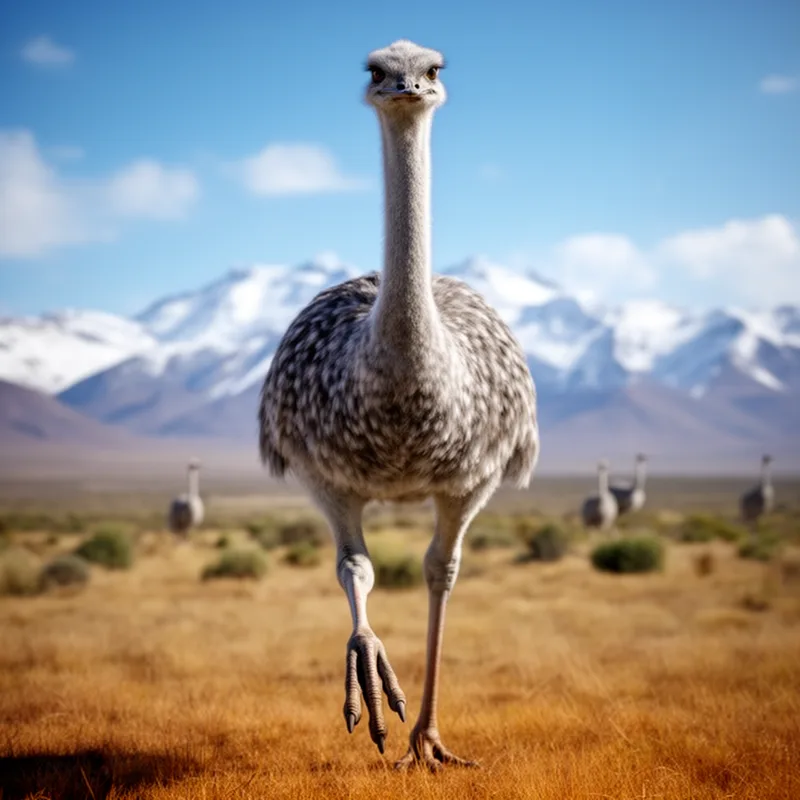
Pterocnemia pennata
- noun
- Specialized
- The Pterocnemia pennata is found in grasslands from Peru to the Strait of Magellan.
Examples
-
Unlike the common rhea, the Pterocnemia pennata is slightly smaller and adapted to colder climates.
-
Naturalists observed a group of Pterocnemia pennata running across the Patagonian steppe.
-
The Pterocnemia pennata is a fascinating bird.
-
Have you ever seen a Pterocnemia pennata in the wild?
-
Naturalists observed a group of Pterocnemia pennata running across the Patagonian steppe.
-
The Pterocnemia pennata is found in grasslands from Peru to the Strait of Magellan.
-
Unlike the common rhea, the Pterocnemia pennata is slightly smaller and adapted to colder climates.
Synonyms


 1
8.9
1
8.9
A large fast-running South American bird like a small ostrich that cannot fly
 1
9.9
1
9.9
A large flightless bird from South America like a small ostrich with three toes
Surface Forms
Morphology
Pterocnemia + pennata
This is a Latin binomial (genus + species). If a learner knows 'Pterocnemia' as a genus of large flightless South American birds, they can infer that Pterocnemia pennata is a species of that bird, but the specific epithet 'pennata' is not a common English word and carries technical/Latin morphology that a B1 learner will not reliably interpret. Because the construction is taxonomic and partially informative but requires specialized knowledge of scientific naming, it is only partially transparent.
Etymology
Pterocnemia pennata comes from old Greek and Latin parts: ptero meaning 'wing', cnemia meaning 'leg', and pennata meaning 'feathered'. The picture of a bird with feathered legs and small wings helps explain why this large, flightless South American bird has that name.