
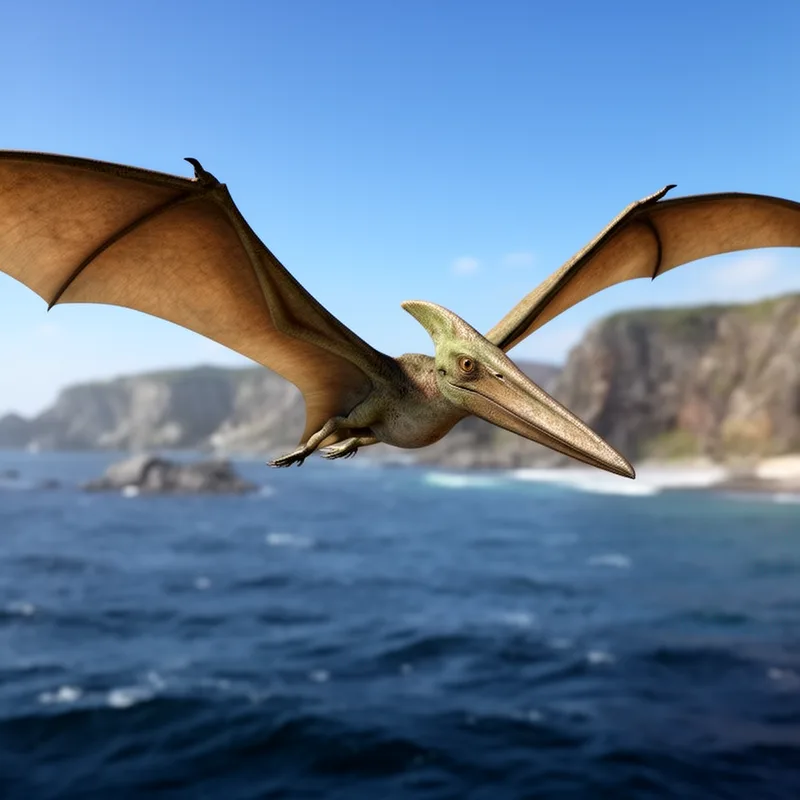
Pteranodon
 1
9.9
1
9.9

- proper noun
- /ˌtɛrəˈnɒdɒn/
- Specialized
- A full-grown Pteranodon, standing over seven feet high, walks upright on clawed feet, its thirty-foot wings folded bat-like at its side.
Examples
-
The Pteranodon rises to its feet, spreads its thirty-foot wings, and flies directly at him.
Fiction book (2001) -
Before Eric has time to cry out, he looks up to find six Pteranodon hatchlings closing in on him with sharp-edged beaks.
Fiction book (2001) -
A Pteranodon flies up out of the trees, the first of twenty.
Fiction book (2001) -
Paul Kirby watches in stunned, abject horror as the Pteranodon carries Eric directly overhead—Paul! Eric!
Fiction book (2001) -
A full-grown Pteranodon, standing over seven feet high, walks upright on clawed feet, its thirty-foot wings folded bat-like at its side.
-
The Pteranodon rises to its feet, spreads its thirty-foot wings, and flies directly at him.
-
At the rear of the hall, Pteranodon longiceps hangs out at an angle from the wall, so that its twenty-foot wingspread seems about to envelop you.
Synonyms
 43
9.7
43
9.7
A flying reptile from long ago with a long thin head and short tail
 5
9.9
5
9.9
A flying reptile that lived in the time of the dinosaurs with thin skin wings like a bat


 1
8.5
1
8.5
An extinct animal with wings like a bat made of skin and supported by one long finger
Surface Forms
Morphology
Pteranodon = ptero + an + odon
Although built from Greek combining forms ('ptero-' wing, 'an-' without, '-odon' tooth), these elements are not productive or familiar to an average learner, so the meaning is not transparently derivable from modern English vocabulary.
Etymology
Pteranodon comes from Greek parts: pter- 'wing', an- 'without', and -odon 'tooth', like in pterodactyl. So the name means 'winged, toothless', which fits a big flying reptile with a long toothless beak.