

Prunus dulcis amara
- noun
- Specialized
- The essential oil derived from Prunus dulcis amara is commonly used as a flavoring agent in liqueurs.
Examples
-
Only processed products of Prunus dulcis amara are safe for human consumption due to the presence of amygdalin in the nuts.
-
The Prunus dulcis amara tree produces beautiful white blossoms.
-
Prunus dulcis amara is cultivated in some regions for its oil, despite the toxicity of the raw nuts.
-
Farmers in California cultivate Prunus dulcis amara for its unique flavor.
-
Prunus dulcis amara produces bitter nuts that are toxic unless they are processed into oil.
-
The oil extracted from Prunus dulcis amara is used for flavoring and has medicinal properties.
-
Due to the toxicity of its raw nuts, Prunus dulcis amara is mainly cultivated for its byproducts.
Synonyms


 1
9.7
1
9.7
A type of almond with poisonous nuts used to make oil for flavor or medicine
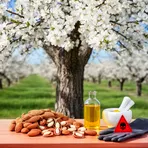
A kind of almond tree with white flowers that has poisonous nuts used to make oil for flavoring and medicine
Surface Forms
Morphology
Prunus + dulcis + amara
This is a scientific Latin binomial (taxonomic name) whose key elements ('dulcis', 'amara') are Latin words not accessible to an average B1 learner and are listed here as not found in the learner-facing dictionary. Even though the Latin roots could, in principle, signal qualities like 'sweet'/'bitter', the technical naming convention and unfamiliar morphology make the overall meaning (a specific bitter almond variety) non-derivable from the given constituents for typical learners.
Etymology
Prunus dulcis amara gets its name from old Latin words. Prunus names the almond tree, dulcis means 'sweet' and amara means 'bitter'. The name gives the picture of an almond tree with sweet flowers but bitter, poisonous nuts, which explains why people only use its oil after careful processing.