

Proxima Centauri
 3
8.2

- proper noun
- /ˈprɒksɪmə sɛnˈtɔːri/
- Specialized
- Look at Proxima Centauri!
Examples
-
Proxima Centauri is nearby.
-
Many stargazers hope to someday visit Proxima Centauri using advanced spacecraft.
-
Proxima Centauri is visible through powerful telescopes from the southern hemisphere.
-
Astronomers discovered a planet orbiting Proxima Centauri in 2016.
-
At a distance of 4.2 light-years, Proxima Centauri is the closest known star to the Sun.
-
Many scientists believe that Proxima Centauri could potentially host planets in its habitable zone.
-
An international team of astronomers studied Proxima Centauri to learn more about its features and behavior.
Synonyms
 4
8.2
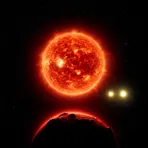
The closest known star to the Sun is about 4.3 light years away in the Centaurus constellation
Surface Forms
Morphology
Proxima + Centauri
The element 'Proxima' is transparently related to English words like 'proximate'/'proximal' meaning 'nearest', so a learner who recognizes that could infer the phrase refers to something nearby. However, 'Centauri' is a proper-name form (from the constellation Centaurus) and is not a standard English lexical item, and proper names are often non-compositional, so the full referent 'the nearest star to the Sun' is only partially deducible.
Etymology
Proxima Centauri comes from Latin words that tell its place in the sky. Proxima means 'nearest' and Centauri means 'of Centaurus', a group of stars named after the centaur, so the name says it is the star nearest to the Sun in that group.