

Protea mellifera
- noun
- Australian
 :
protea melífera
:
protea melífera
- The Protea mellifera is commonly cultivated for its abundant honey production.
Examples
-
The blossoms of Protea mellifera attract large numbers of bees during flowering season.
-
Many beekeepers in the region plant Protea mellifera to support their hives.
-
The Protea mellifera is known for its sweet nectar.
-
Many bees are attracted to Protea mellifera flowers.
-
Many beekeepers in the region plant Protea mellifera to support their hives.
-
The Protea mellifera is commonly cultivated for its abundant honey production.
-
The blossoms of Protea mellifera attract large numbers of bees during flowering season.
Synonyms
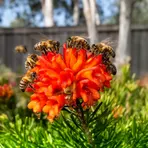
A small Australian plant with flowers that make a lot of sweet nectar for bees
Surface Forms
Morphology
Protea + mellifera
This is a taxonomic binomial whose parts are compositional: Protea (a genus of shrubs) + mellifera (from Latin melli- ‘honey’ + -fera ‘bearing’), so a learner who knows both constituents can directly infer ‘a Protea that produces honey or abundant nectar’. However, mellifera is a Latin scientific epithet not usually found in learners' dictionaries, so in practice many B1 learners would not recognize the second element despite the transparent morphology.
Etymology
Protea mellifera is a shrub with flowers full of nectar that attract large numbers of bees. Its second name, mellifera, even means 'honey-bearing', so beekeepers plant it to feed their hives and that's why the plant is known for producing a lot of honey.

