
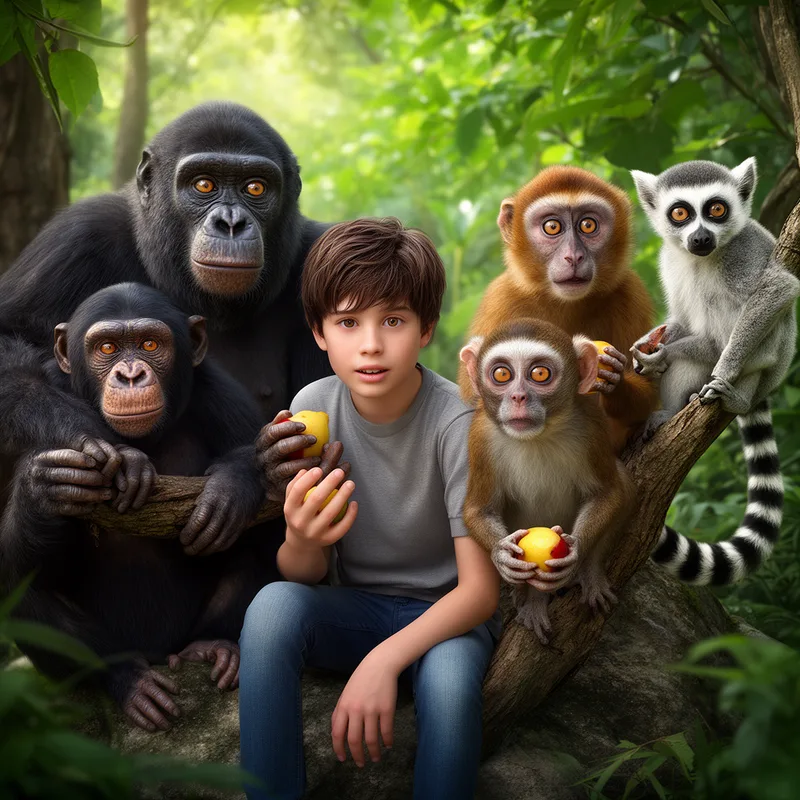
Primates
 7
3.7

- noun
- /ˈpraɪˌmeɪts/
- Specialized
- And we're social entities in a way that is continuous with our non human primate ancestors.
Loading YouTube…
Watch on YouTubeI love to remind people that we're primates, old world primates.
- I love to remind people that we're primates, old world primates.
- Again, to refer back to the primate brain.
- There were there were early primates in Madagascar, early primates in Africa when Madagascar split off.
- So rodent vision is mud is very, very much poorer than than primate vision.
- But some birds, much like primates, take it one step further.
- And humans among primates have just exploded that hardware.
- People who have been abducted by monkeys, primates, women who have Barbie vaginas.
Examples
-
It's one of many nationally funded primate research centers.
-
Think about the primates, you know, Old World and New World.
-
I love to remind people that we're primates, old world primates.
-
Of course, it's not just us human primates who are affected by epidemics.
-
He has spent a lot of his academic life studying primates and other wildlife in Africa.
-
That includes non human primates like gorillas and chimpanzees.
-
Meanwhile, some primates, like the eye eyes of Madagascar, have reacquired claws.
-
Many primates, such as monkeys and apes, exhibit complex social behaviors.
-
Researchers are focusing on the conservation of various primates around the world.
-
Primates have unique traits, including large brains and forward-facing eyes.
Synonyms
 57
4.0
A mammal like a monkey, ape, or human
Surface Forms
Morphology
Etymology
Primates comes from the Latin word primus, meaning 'first', and it shares the same root as the English word prime. Scientists used this name for the group because it includes humans and other animals with larger brains and grasping hands, so Primates hints at their 'first' or top place among mammals.