
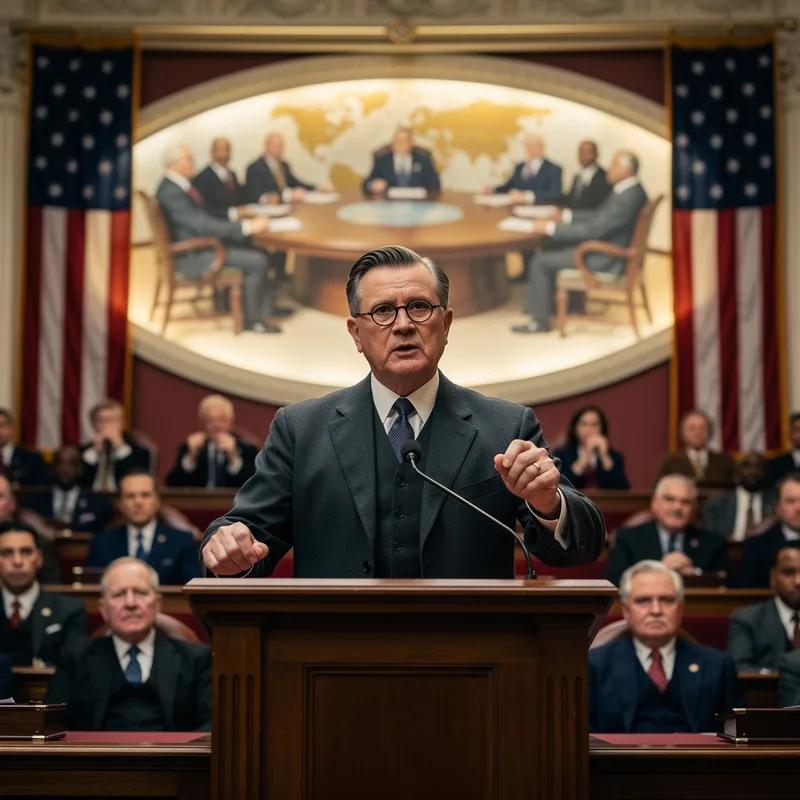
President Wilson
 8
5.1

- proper noun
- /ˈprɛzɪdənt ˈwɪlsən/
- Her credentials for the job were impressive: she spoke nine languages, knew several European heads of state in person, and was received twice by President Wilson, who was the number one hope of the Hungarians on account of his Fourteen Points.
- President Wilson in 1918
Examples
-
On March 2, the Senate began consideration of President Wilson's proposal.
Academic text (2004) -
Some questioned whether President Wilson truly would reward their efforts by recognizing Lithuania's independence once the war was over.
Academic text (1998) -
In 1917, as you know, President Wilson declared war on Germany.
Fiction book (1996) -
On October 2, 1919, President Wilson suffered a stroke that left half of his body paralyzed.
Academic text (2014) -
Mr. Ince's movie was in release by then, and he'd been invited to the White House by President Wilson, another advocate for peace.
Fiction book (1996) -
In February 1920, President Wilson forced Lansing to resign after learning of Lansing's attempts to have him declared disabled.
Academic text (2014) -
A more explicit reference to the idea of self-determination was made by President Wilson in his Fourteen Points, announced in a speech to the U.S. Senate on 8 January 1918.
Academic text (1990) -
In 1918, with the peace negotiations in sight, Kahn became concerned that Zionist activists preparing to influence President Wilson might do more harm than good.
Academic text (1991) -
Although they were not entirely sure of his motives, Lithuanian socialist leaders praised President Wilson for standing up against the majority in Congress by denouncing principal portions of the Dillingham bill.
Academic text (1998) -
In 1917, as you know, President Wilson declared war on Germany.
Synonyms
 16
4.8
A US President who led the country in World War I and tried to start the League of Nations
Surface Forms
Morphology
President + Wilson
The phrase is a straightforward combination of the title 'President' and the proper name 'Wilson', so a learner who knows both constituents will understand it refers to a president named Wilson. Determining the specific historical identity (e.g., Woodrow Wilson, the 28th President) requires extra world knowledge but the basic referential meaning is transparently compositional.
Etymology
President Wilson is the title president plus the family name Wilson, a name that originally meant 'son of Will'. It refers to the man who led the United States during World War I and who worked to create the 'League of Nations', so when you hear President Wilson it means that specific historical leader.