
Preclassic
- noun
- /ˈpriːˌklæsɪk/
- Specialized
- Elsewhere in the Maya Lowlands, soil erosion started in the Preclassic period as pioneer farmers first confronted their lands, perhaps as agriculture first expanded onto these steep, tropical slopes (Dunning and others 1999).
- Preclassic period
- late Preclassic
- Early Preclassic
Examples
-
Indeed, much of the depositional landscape from the Preclassic period is buried by eroded sediment from subsequent eras.
Academic text (2002) -
Organic sediments, buried 95-170 centimeters deep in these soils, date to the Early Preclassic period (early second millennium B.C.). Radiocarbon dating showed (Table II, samples 2, 3, and 5).
Academic text (2002) -
Indeed, we have found many buried soils in the depressions of the Three Rivers region that date to the Preclassic period and before.
Academic text (2002) -
Maya religion in the Preclassic and Classic periods exalted the maize god and tied royal power to him.
Academic text (2007) -
The earliest artifacts found in the Three Rivers region are nonstructural materials dating to the Middle Preclassic period (900-400 B.C.).
Academic text (2002) -
Downvalley from the Late Classic terraces in La Milpa Drainage 1 are a cluster of buried soils that date to the Early Preclassic period.
Academic text (2002) -
The first accelerated soil erosion occurred during the Preclassic period (1500 B.C. – A.D. 250).
Academic text (2002) -
One of the earliest and most prominent of these was the large town of Cerros, on Chetumal Bay in northern Belize, which dates from the late Preclassic (300 B.C.-A.D. 300).
Academic text (1991) -
Large-scale urbanization did not begin until the Late Preclassic–Protoclassic period (400 B.C.–A.D. 250), when monumental buildings were constructed in the centers of large sites.
Academic text (2002) -
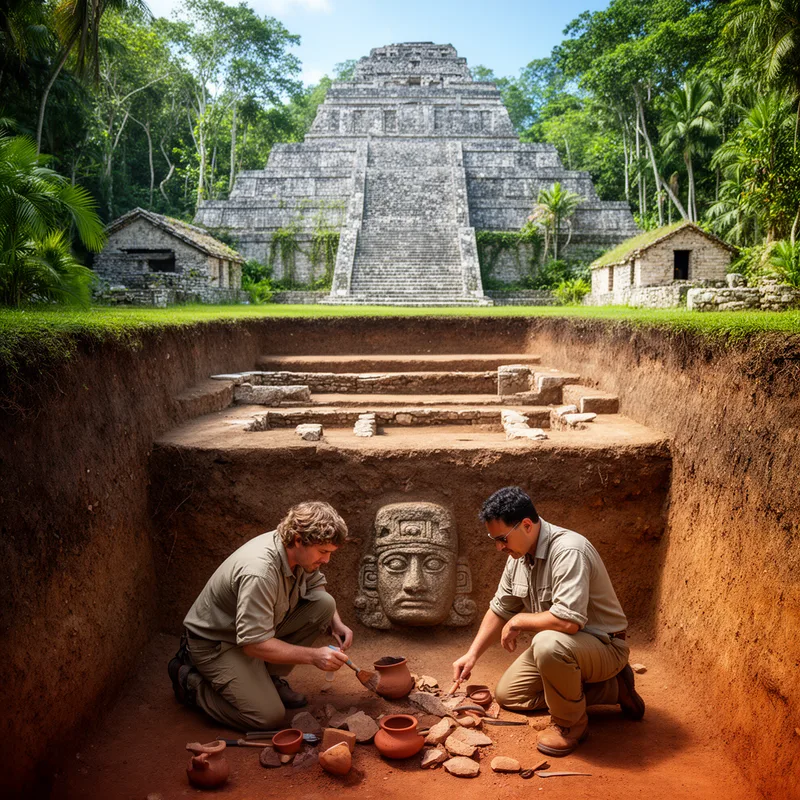
Archaeologists have discovered important structures that were built during the Preclassic period, revealing insights into early Mesoamerican societies.
Surface Forms
Morphology
Etymology
Preclassic combines the prefix pre- meaning 'before' and the familiar word classic, which often means 'belonging to the main or most important period'. So Preclassic refers to the time 'before' a culture's classical era, which is why archaeologists use it for the period just before the classical age.

