

Post-impressionist


 1
8.9
1
8.9
- noun
- /ˌpoʊstɪmˈprɛʃənɪst/
- Georges Seurat is often considered one of the most important post-impressionists for his development of pointillism.
- post-impressionist paintings
- collection of post-impressionist
Examples
-
Virginia Woolf visited an exhibit of post-impressionist paintings and wrote, "In or about December, 1910, human nature changed."
Academic text (2014) -
With Bernard, he also moved into post-impressionist territory, exploring the use of flat.
Blog text (9) -
With Bernard, he also moved into post-impressionist territory, exploring the use of flat areas of color bounded by heavy outlines.
Blog text (9) -
Post-Impressionists such as Georges Seurat and Paul Signac were influenced in more or less unscientific ways by books containing color solids and patches.
Academic text (1995) -
Vincent van Gogh, a renowned post-impressionist, created vibrant works that convey deep emotion.
-
Many art critics believe that post-impressionist artists like Paul Gauguin transformed the approach to color in painting.
Synonyms
 1
9.9
1
9.9
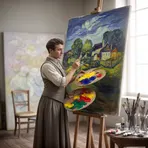
A painter who used bold colour and new styles after Impressionism in the late 1800s
How Colorful
1
9.9

- Specialized
4
7.8
1
8.9
12
7.2
4
5.3
- Specialized
Surface Forms
Morphology
Post-impressionist = impressionist (transparent) = post + impressionist
The prefix 'post-' meaning 'after' combines directly with 'impressionist' to indicate an artist after or reacting to Impressionism, a derivation readily inferable by learners.
Etymology
Post-impressionist comes from the parts post- meaning 'after' and impression meaning a quick feeling or image, as in 'first impression'. So a Post-impressionist is an artist who came after the Impressionists and tried new styles beyond their quick, light 'impressions' of a scene.