
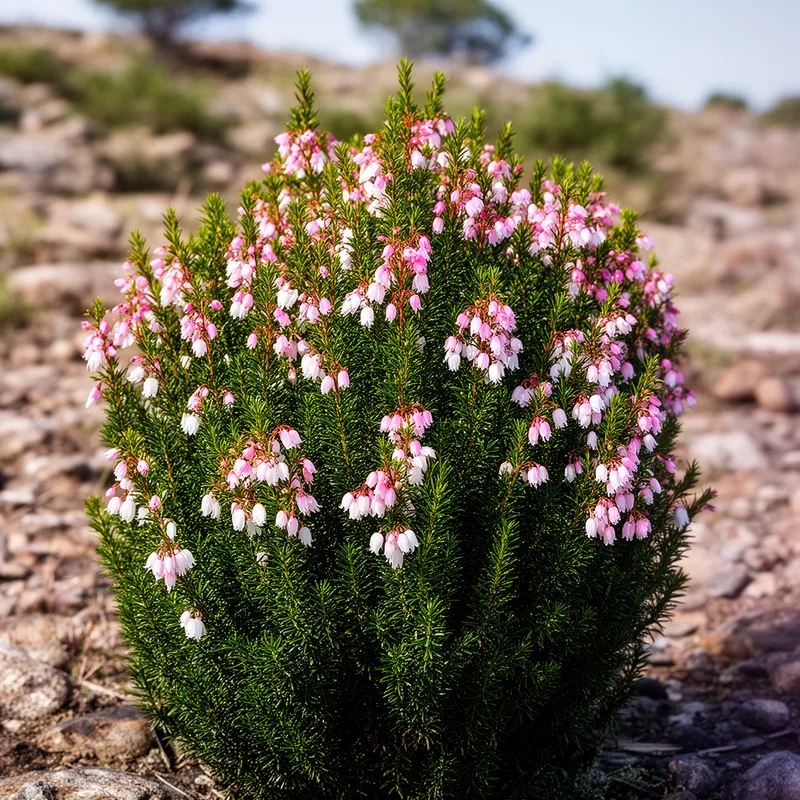
Portuguese heath
- noun
- UK
- The Portuguese heath produces clusters of bell-shaped pink flowers in the spring.
Examples
-
In its native habitat, Portuguese heath thrives on rocky hillsides and poor soils.
-
Gardeners in England often plant Portuguese heath for its attractive evergreen foliage.
-
The Portuguese heath blooms beautifully in spring.
-
Many gardeners love the Portuguese heath for its vibrant flowers.
-
Gardeners in England often plant Portuguese heath for its attractive evergreen foliage.
-
In its native habitat, Portuguese heath thrives on rocky hillsides and poor soils.
-
The Portuguese heath produces clusters of bell-shaped pink flowers in the spring.
Synonyms

A small evergreen shrub with many pale pink or white flowers
Surface Forms
Morphology
The phrase is a straightforward noun phrase combining an origin adjective 'Portuguese' with the noun 'heath' (a small evergreen shrub), so its meaning — a heath associated with Portugal — is directly derivable from the parts. This adjectival-noun naming pattern for species or regional varieties is cross-linguistically common, making the expression immediately understandable to a learner who knows both constituents.
Etymology
Portuguese heath comes from a simple picture: it is a small evergreen shrub, a heath, that grows wild around Portugal and nearby Spain. So the name points to a 'heath' plant from Portugal, and that's why today Portuguese heath means that evergreen shrub with pink or white flowers.

