

Port Arthur
- proper noun
 :
Puerto Arturo
:
Puerto Arturo
- The Japanese army faced stiff resistance while advancing toward Port Arthur.
Examples
-
The Russians converted Port Arthur, at the peninsula's southern tip, into an ice-free naval base.
-
Many historians discuss the strategic importance of Port Arthur in East Asian military history.
-
The capture of Port Arthur marked a turning point in the First Sino-Japanese War.
-
I visited Port Arthur last summer.
-
Have you ever been to Port Arthur?
-
On February 8, 1904, the Japanese navy launched a surprise attack on the Russian Pacific Fleet at Port Arthur, resulting in considerable damage.
-
On January 2, 1905, Port Arthur surrendered, allowing the Japanese Third Army to join the other armies outside Mukden.
Synonyms
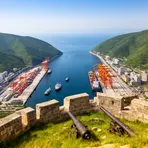
A district in northeastern China on the Liaodong Peninsula with an old port once called Port Arthur

A large port city in northeast China on the Liaodong Peninsula now part of Dalian

A port in China, Korea, or Japan opened to foreign trade by treaty in the 1800s and early 1900s
Surface Forms
Morphology
port + Arthur
The combination of 'port' (harbor) and 'Arthur' (a personal name) allows a B1 learner to infer that this is a place — a port called Arthur — so the basic referential meaning is derivable from the parts. However, the precise identification (that it is the northeastern Chinese city and its historical military significance) cannot be inferred from the constituents alone, so the expression is only partially transparent.
Etymology
Port Arthur may come from Western sailors who called the bay Port after an officer named Arthur, and the name simply stayed. Because it was an important harbour, Port Arthur later became the site of big military fights, so today the name refers to that port city and its wartime history.

