
Pop Art
 4
4.4
4
4.4

- noun
- /pɑp ɑrt/
- Sussman believes that three factors led to a reevaluation of Stettheimer's art in the 1980s: gay liberation, the rise of Pop art, and the women's movement.
- history of Pop Art
Loading YouTube…
Watch on YouTubeI'm I'm an old cartoonist and I have also that great interest, so the pop art seems a very trivial thing to me.
- I'm I'm an old cartoonist and I have also that great interest, so the pop art seems a very trivial thing to me.
Examples
-
Just beyond MoMA's sprawling, unsettling Abstract Expressionist New York exhibition was a small gallery devoted to pop art.
Academic text (2011) -
Proof of California Pop's marginalization came when Pop Art, the first comprehensive book on the subject, was published in 1966.
Academic text (2005) -
Another example comes also from the Pop Art era, and that has to do with comic books.
-
Pop art and popular art were both used at this time to refer approvingly to the products of the mass media.
Academic text (2005) -
Warhol, guru of pop art, has died in New York.
-
Alexandra Schwartz offers a historiographic study of the development of Los Angeles pop art in the 1960s.
Academic text (2005) -
Pop art glorified the image of America's surface while exposing the violence of consumerism.
Academic text (2005) -
The New Painting of Common Objects, now widely acknowledged as the first American survey of Pop art, was organized by Hopps for the Pasadena Art Museum in September 1962.
Academic text (2005) -
In the play Red, Rothko worries about being overtaken by pop art—and about his work being seen as fixed in time rather than traveling through time.
Academic text (2011) -
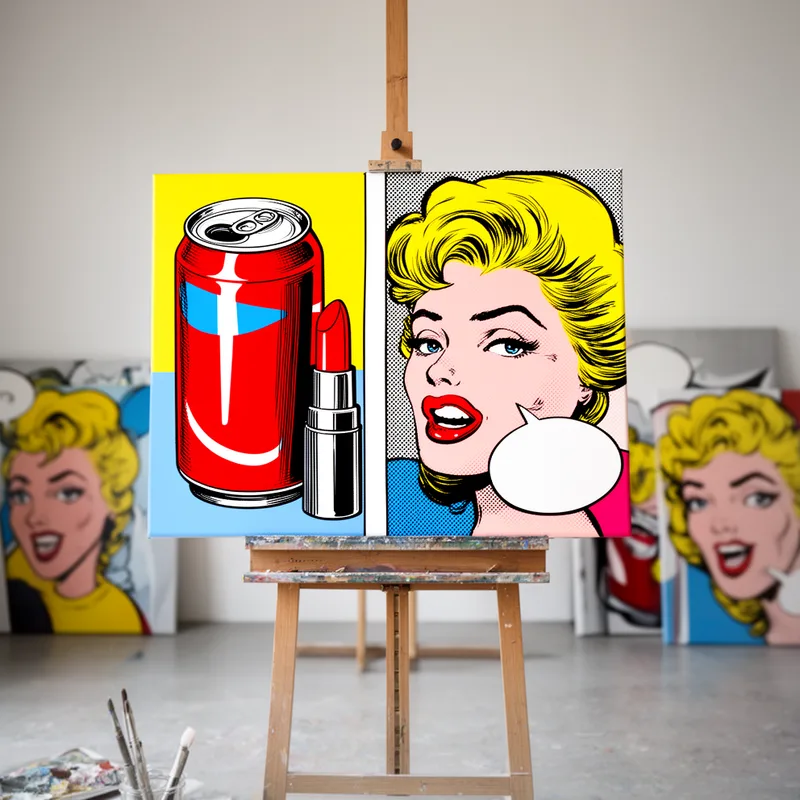
The Pop Art movement brought everyday consumer items into the realm of fine art.
Surface Forms
Morphology
The meaning 'art derived from popular culture' is largely inferable from combining 'pop' (popular/pop culture) with 'art', so learners who interpret 'pop' as 'popular' can derive the MWE. However, because 'pop' is also commonly known as a music genre, some B1 learners might misinterpret it as art related specifically to pop music rather than the broader popular-mass-culture sense, making the relation only partially predictable.
Etymology
Pop Art gets its name from the word Pop, which comes from 'popular', and the word Art. Artists copied images from everyday 'popular culture' such as ads, comics and product labels into paintings and prints, so Pop Art means art made from the familiar images many people see every day.