
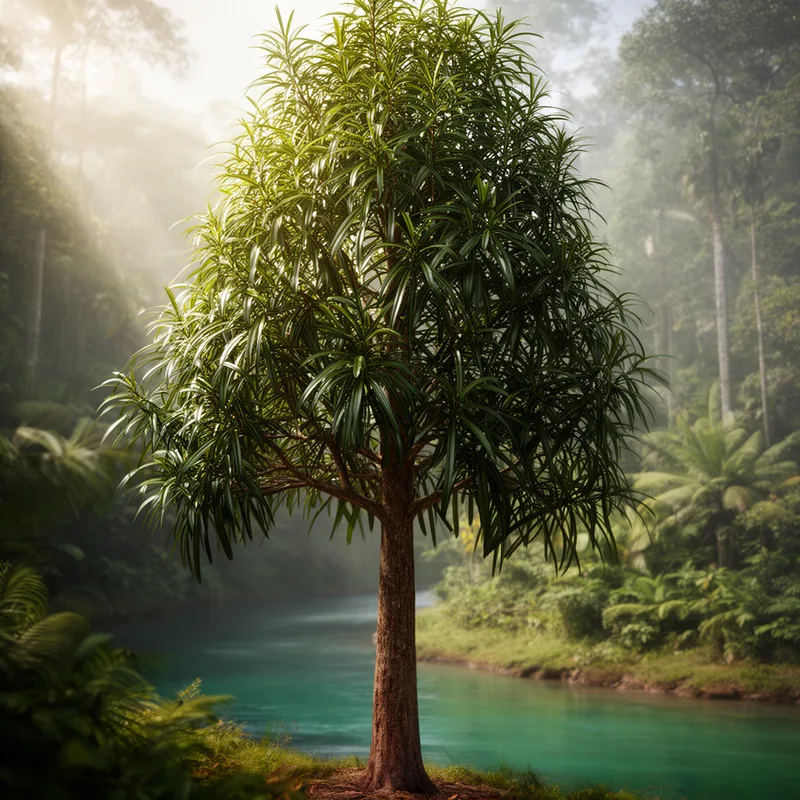
Podocarpus amara
- noun
- Specialized
- The Podocarpus amara thrives in the rainforests of northern Queensland, where it can reach impressive heights.
Examples
-
Local guides pointed out a mature Podocarpus amara growing near the riverbank in Sumatra.
-
Many gardeners prefer Podocarpus amara for its lush foliage.
-
Botanists studied the leaves of Podocarpus amara for their glossy appearance and unique structure.
-
The Podocarpus amara thrives in tropical climates.
-
In the rainforests of Sumatra, the towering Podocarpus amara showcases its large, glossy leaves.
-
The fast-growing Podocarpus amara can often be found in the rainforest, where it flourishes due to the rich soil.
-
Gardeners admire the Podocarpus amara for its vibrant foliage and ability to thrive in warm, humid environments.
Synonyms
A large evergreen tree with shiny long leaves that grows in humid rainforests of Southeast Asia and northern Australia

A large evergreen tree with shiny long leaves that grows quickly in tropical rainforests
Surface Forms
Morphology
Podocarpus + amara
Knowing 'Podocarpus' (a genus of evergreen trees) lets a learner infer this is a kind of Podocarpus — i.e. an evergreen tree — but the species epithet 'amara' has no dictionary gloss here and functions as a Latin proper name. The precise descriptive meaning (large, fast-growing tropical evergreen) is not derivable from the constituents by a B1 learner, so the term is only partially predictable.
Etymology
Podocarpus amara may come from Greek podo- meaning 'foot' and -carpus meaning 'fruit', giving the image of a small fruit on a short stalk like a little foot, and amara is Latin for 'bitter'. So the name helps you picture a rainforest tree with stalked fruits and some bitter parts, which fits this species.

