

Platycladus orientalis
- noun
- Specialized
- The landscape architect recommended Platycladus orientalis for its year-round greenery and low maintenance.
Examples
-
The Platycladus orientalis in our garden grew much taller than we expected.
-
Many parks in Europe feature mature specimens of Platycladus orientalis along their walking paths.
-
The beautiful Platycladus orientalis adds charm to any garden.
-
Many homeowners choose Platycladus orientalis for its low maintenance.
-
Many parks in Europe feature mature specimens of Platycladus orientalis along their walking paths.
-
The Platycladus orientalis in our garden grew much taller than we expected.
-
The landscape architect recommended Platycladus orientalis for its year-round greenery and low maintenance.
Synonyms

An evergreen shrub or small tree from Asia with dense leaves often planted in gardens
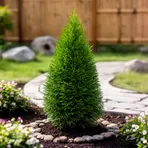
An evergreen shrub or small tree from Asia that people often plant in gardens
Surface Forms
Morphology
Platycladus + orientalis
This is a Latin scientific name (a taxonomic label) whose parts are not common English words and are listed here as not found in the dictionary; the phrase functions as a proper name for a species rather than a compositional phrase. Even if a learner recognised that 'orientalis' is related to 'oriental' (eastern), the overall meaning (an ornamental evergreen shrub) is not derivable from the constituents, so a B1 learner who only knows the listed words would not be able to infer the referent.
Etymology
Platycladus orientalis comes from Latin words: Platycladus meaning 'flat branch' and orientalis meaning 'from the east'. That image helps you remember the plant: it has flat, plate-like leaves and comes from Asia, so the name points to this eastern evergreen people plant in gardens.

