
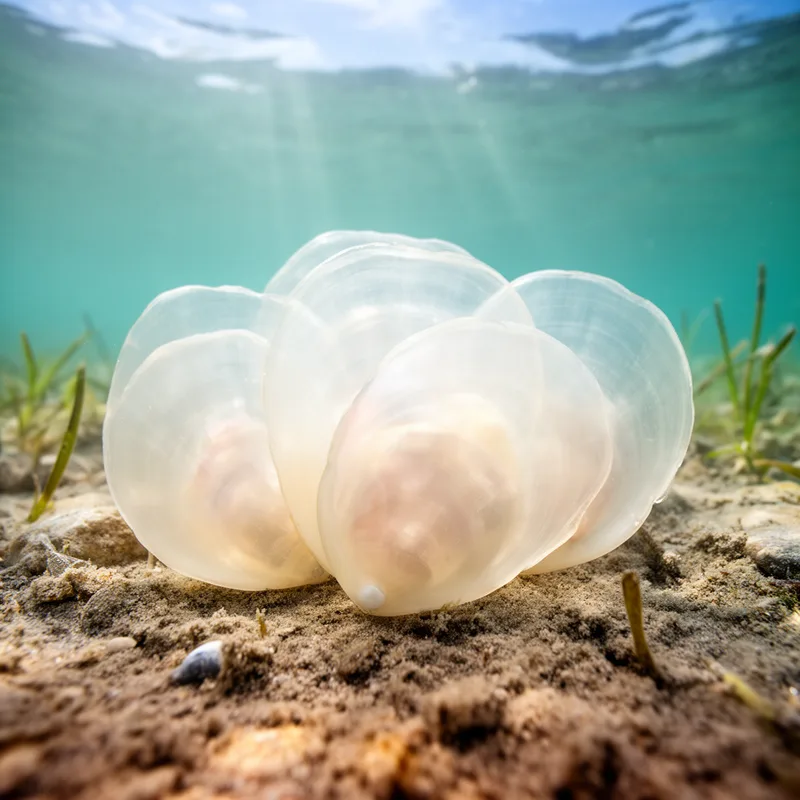
Placuna placenta
- noun
- Specialized
- Researchers are studying the habitat of Placuna placenta to support conservation efforts.
Examples
-
The Placuna placenta is commonly found in shallow waters.
-
Harvesting Placuna placenta is a significant coastal livelihood in some parts of the Philippines.
-
The delicate shell of the Placuna placenta is prized for making decorative items and windowpanes.
-
Many divers enjoy searching for Placuna placenta in the Philippines.
-
Harvesting Placuna placenta is a vital source of income for local communities in the Philippines.
-
The thin shell of the Placuna placenta is often used in art and craft projects.
-
Many people enjoy collecting the beautiful shells of Placuna placenta along the shoreline.
Synonyms

A sea animal with a large thin shell that people use for decoration and for food

A large thin shell from a sea animal used for food and crafts

A thin translucent shell from the Philippines used for decoration
Surface Forms
Morphology
Placuna + placenta
This is a Latin binomial (taxonomic) name referring to a species (the windowpane oyster) and the craft material derived from its shell; that specialized referent is not compositionally derivable from the constituent words. Even if a learner knows 'Placuna' (a bivalve genus) and 'placenta' (which is ambiguous or known as an anatomical term), they would need specialist knowledge to infer the meaning 'thin translucent shell/sheets used for decoration', so it is not transparently understandable at B1.
Etymology
Placuna placenta may come from old words meaning a 'flat plate' or 'flat cake', because the oyster has a very thin, flat, see-through shell. That's why people call it the 'windowpane oyster' and why the name fits this sea animal.

