
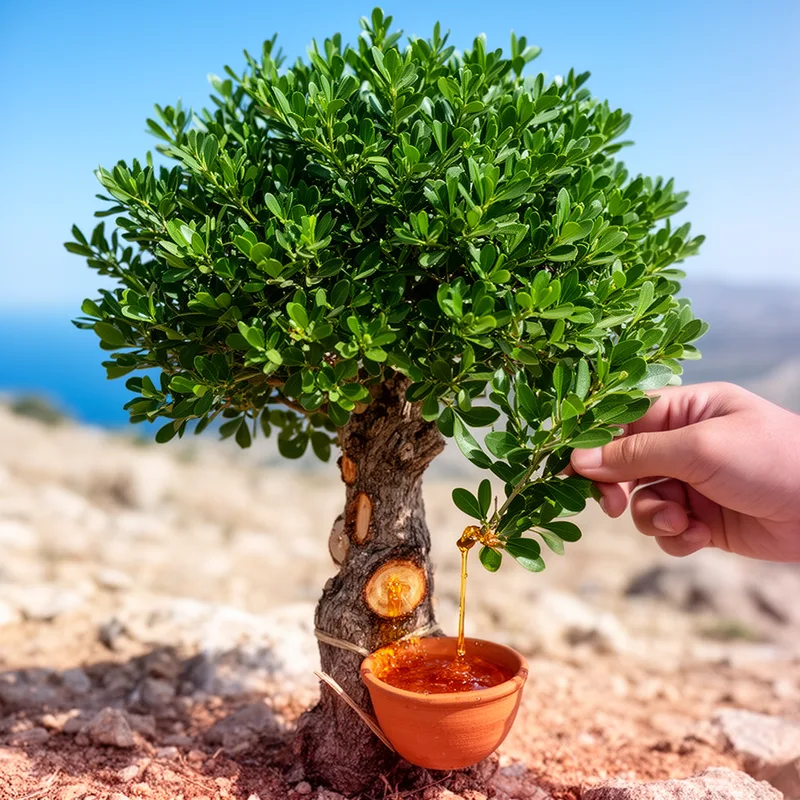
Pistacia terebinthus
- noun
- Specialized
- The resin obtained from the Pistacia terebinthus tree has been valued since ancient times.
Examples
-
In Mediterranean forests, Pistacia terebinthus is recognized for its aromatic leaves and fruit.
-
The Pistacia terebinthus tree is native to the Mediterranean region.
-
Chian turpentine, an important export, is produced by the Pistacia terebinthus.
-
Many artisans use resin from the Pistacia terebinthus for their crafts.
-
The Pistacia terebinthus tree is often used to produce a valuable aromatic resin.
-
Artisans craft products using the resin harvested from the Pistacia terebinthus tree.
-
In the Mediterranean, the Pistacia terebinthus is known for its compound leaves and turpentine.
Synonyms


 1
9.9
1
9.9
A small tree that grows near the Mediterranean and makes a sticky sap used for medicine and incense
Surface Forms
Morphology
Pistacia + terebinthus
This is a scientific Latin binomial that literally names a species of the genus Pistacia, so if a learner knew both constituents and the convention of binomial nomenclature they could infer it denotes a type of Pistacia tree. However, the phrase uses technical/Latin vocabulary (the species epithet is not a common English word and is missing a dictionary gloss here), so it is not immediately predictable or accessible to an average B1 learner without specific botanical or nomenclatural knowledge.
Etymology
Pistacia terebinthus may come from old Greek words: Pistacia (the pistachio group) and terebinthus (a tree that gives a sticky, scented resin like 'turpentine'). So the name fits a small Mediterranean tree known for its aromatic resin and leaves.