
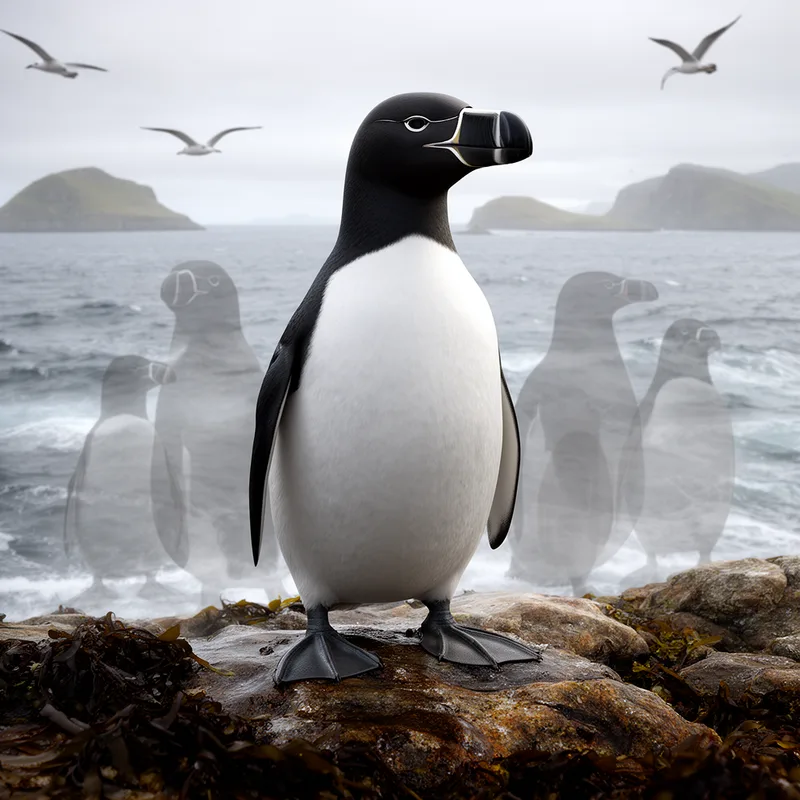
Pinguinus impennis
- noun
- Specialized
- Once common on rocky North Atlantic islands, Pinguinus impennis disappeared by the mid-1800s.
Examples
-
The extinction of Pinguinus impennis serves as a stark reminder of human impact on wildlife.
-
Scientists have studied the bones of Pinguinus impennis to learn more about its behavior and habitat.
-
The Pinguinus impennis was a remarkable bird.
-
Did you know that the Pinguinus impennis is extinct?
-
Once common on rocky North Atlantic islands, Pinguinus impennis disappeared by the mid-1800s.
-
Scientists have studied the bones of Pinguinus impennis to learn more about its behavior and habitat.
-
The extinction of Pinguinus impennis serves as a stark reminder of the fragility of wildlife.
Synonyms

A large seabird that could not fly and lived on rocky islands in the northern Atlantic and is now extinct
Surface Forms
Morphology
Pinguinus + impennis
The components 'Pinguinus' and 'impennis' are Latin taxonomic elements rather than common English words, so a B1 learner who knows everyday English vocabulary would not be able to derive 'great auk' or its extinct, flightless-seabird meaning from them. Although the parts can be analyzed by someone with knowledge of Latin/biological morphology (e.g., im- negation, pennis related to wings), that specialist knowledge is beyond B1, making the binomial effectively idiomatic and non-compositional for typical learners.
Etymology
Pinguinus impennis is a scientific Latin name that gives a clear picture: Pinguinus was used for a big seabird and impennis means 'without wings', so the name shows it was a large flightless bird. That's why Pinguinus impennis refers to the great auk, a sea bird that died out in the 1800s.

