
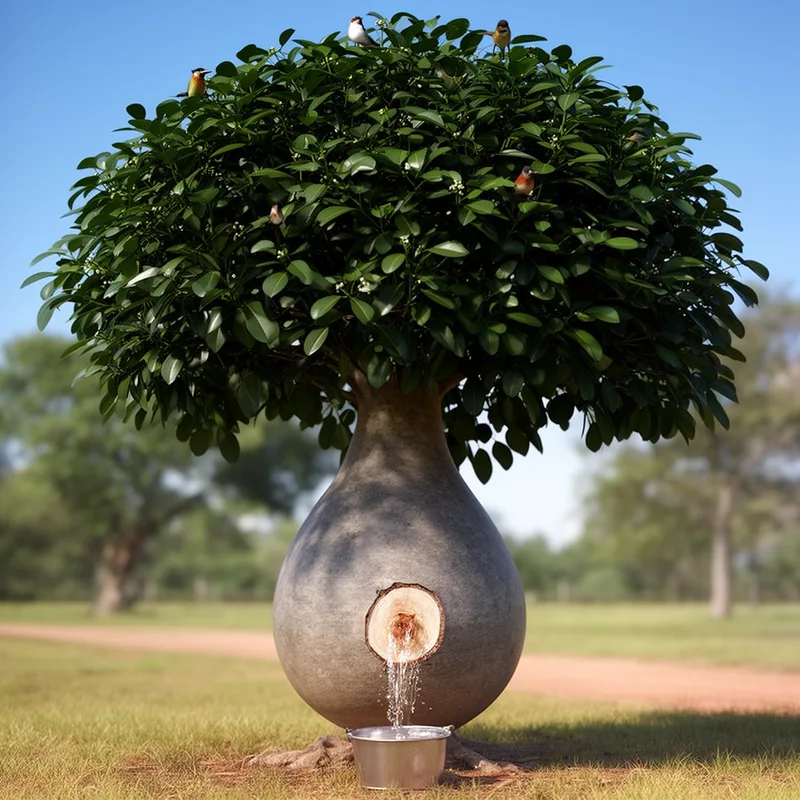
Phytolacca dioica
- noun
- Specialized
- The park was shaded by a giant Phytolacca dioica that dominated the landscape.
Examples
-
The broad canopy of Phytolacca dioica provides shelter for many species of birds.
-
The Phytolacca dioica tree can grow up to 15 meters tall.
-
Botanists studied the unique trunk structure of Phytolacca dioica in its native habitat.
-
In South America, Phytolacca dioica is often found near rivers.
-
The broad leaves of Phytolacca dioica are a distinctive feature of this evergreen tree.
-
In the gardens of South America, Phytolacca dioica stands out with its thick, water-rich trunk.
-
Local wildlife often seeks refuge in the shade provided by the tall Phytolacca dioica trees.
Synonyms

A fast-growing evergreen tree with a thick water-filled trunk and dark oval leaves that gives shade

A large South American tree with a wide trunk that stores water and dark green leaves
Surface Forms
Morphology
Phytolacca + dioica
The form is a Latin binomial: knowing 'Phytolacca' (a plant genus) would allow a learner to infer this is the name of a plant species, but the full descriptive meaning ('a fast-growing evergreen tree native to South America') and the specialized sense of 'dioica' are not derivable from common English knowledge. Because the constituents give only a partial cue (that it is a plant species) but not the specific properties, the expression is only partially predictable to learners.
Etymology
Phytolacca dioica may come from Greek parts: phyto- meaning 'plant' and -lacca meaning 'sticky juice', while dioica means 'two houses', that is, male and female flowers on different trees. So the name gives a simple picture to remember: a plant with dark, sticky sap and separate male and female trees.

