
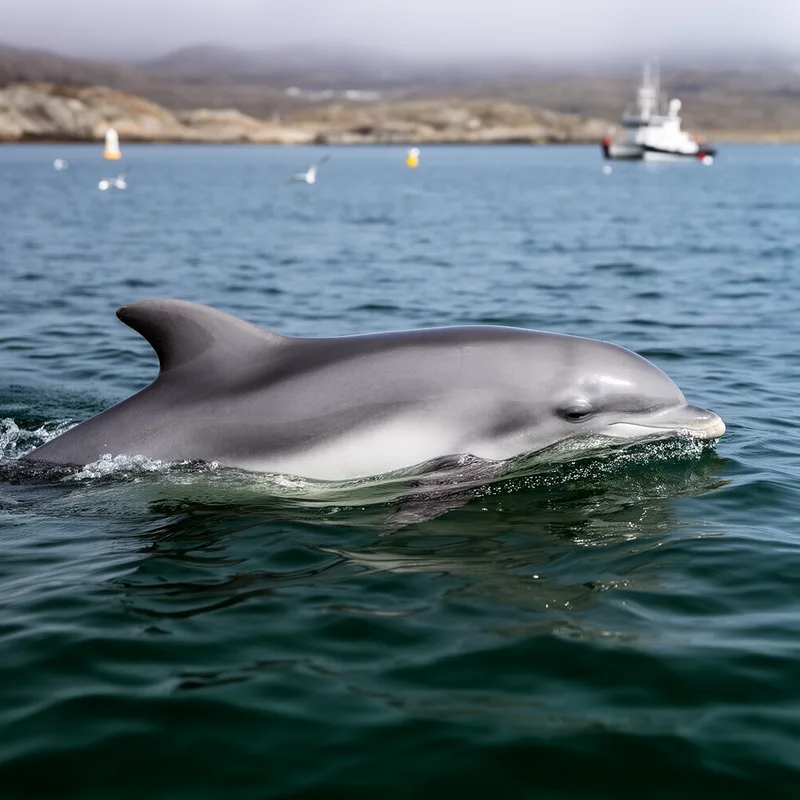
Phocoena phocoena
- noun
- Specialized
- The Phocoena phocoena is sometimes called the harbour porpoise because it frequents coastal waters.
Examples
-
Researchers observed a pod of Phocoena phocoena near the coast during their marine survey.
-
Despite conservation efforts, populations of Phocoena phocoena have declined in some regions due to fishing nets and pollution.
-
The Phocoena phocoena is often seen near the coast.
-
Many researchers study the Phocoena phocoena in their natural habitat.
-
Researchers observed a pod of Phocoena phocoena near the coast during their marine survey.
-
Despite conservation efforts, populations of Phocoena phocoena have declined in some regions due to fishing nets and pollution.
-
The Phocoena phocoena is sometimes called the harbour porpoise because it frequents coastal waters.
Synonyms

A small sea animal like a dolphin that lives near coasts in the northern Atlantic and Pacific

A small sea animal like a dolphin that lives near coasts and eats fish
Surface Forms
Morphology
This is a Latin binomial (genus + species) where each constituent labels the porpoise genus; a learner who knows 'Phocoena' can infer the phrase denotes a porpoise species but will not reliably derive the specific common-name meaning 'common porpoise' without knowledge of taxonomic naming conventions. Because part of the meaning (that it refers to a porpoise species) is recoverable from the constituents but the exact referent requires extra domain knowledge, the expression is only partially transparent to a B1 learner.
Etymology
Phocoena phocoena may come from an old Greek word for 'seal' because early sailors and scientists thought this small porpoise looked like a little seal, with a short body and rounded head. So the scientific name points to the animal's small, seal-like shape.

