
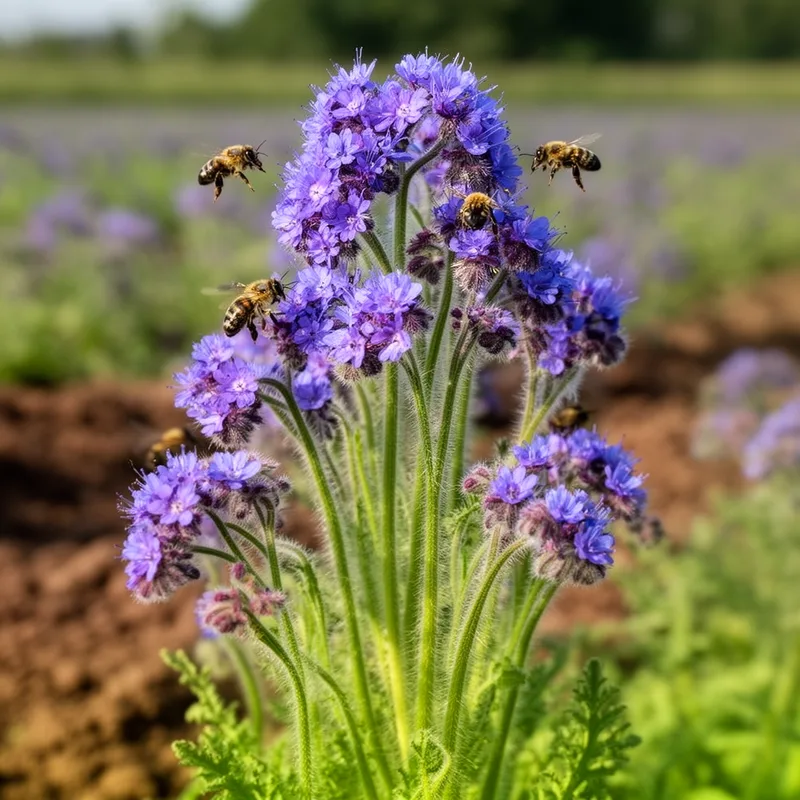
Phacelia tanacetifolia
- noun
- /fəsˈiːliə ˌtænəˌsɛtɪˈfoʊliə/
- Specialized
- The gardener planted rows of Phacelia tanacetifolia for its beautiful blue flowers and pollinator benefits.
Examples
-
In California, fields of Phacelia tanacetifolia bloom in spring, creating a vibrant display.
-
Phacelia tanacetifolia is often used as a cover crop to attract bees and improve soil health.
-
The garden is filled with Phacelia tanacetifolia this spring.
-
Many gardeners love Phacelia tanacetifolia for its beautiful blooms.
-
Phacelia tanacetifolia is often grown in gardens to attract pollinators with its beautiful blue flowers.
-
Many farmers plant Phacelia tanacetifolia to help revitalize soil and draw in beneficial insects.
-
In California's climate, Phacelia tanacetifolia thrives and produces stunning clusters of lilac flowers.
Synonyms
A small plant with clusters of blue or purple flowers that bees like
A group of North American wild plants with blue, purple, or white flowers
Surface Forms
Morphology
phacelia + tanacetifolia
This is a scientific binomial: the genus name 'Phacelia' plus the specific epithet 'tanacetifolia' together denote a species of Phacelia, so the overall meaning is compositionally built from its parts (genus + descriptive epithet). Although 'tanacetifolia' is a technical Latin-form epithet that most B1 learners would not know, if a learner did know both constituents they could infer it refers to a Phacelia with tansy-like leaves, making the name transparently interpretable.
Etymology
The noun Phacelia tanacetifolia may come from older words that describe the plant: Phacelia for a 'bundle' because its small flowers grow in tight clusters, and tanacetifolia for 'tansy-like leaves' because its leaves look like the tansy plant. So the name helps you remember a hairy annual with many blue flowers that gardeners plant to 'attract pollinators'.

