
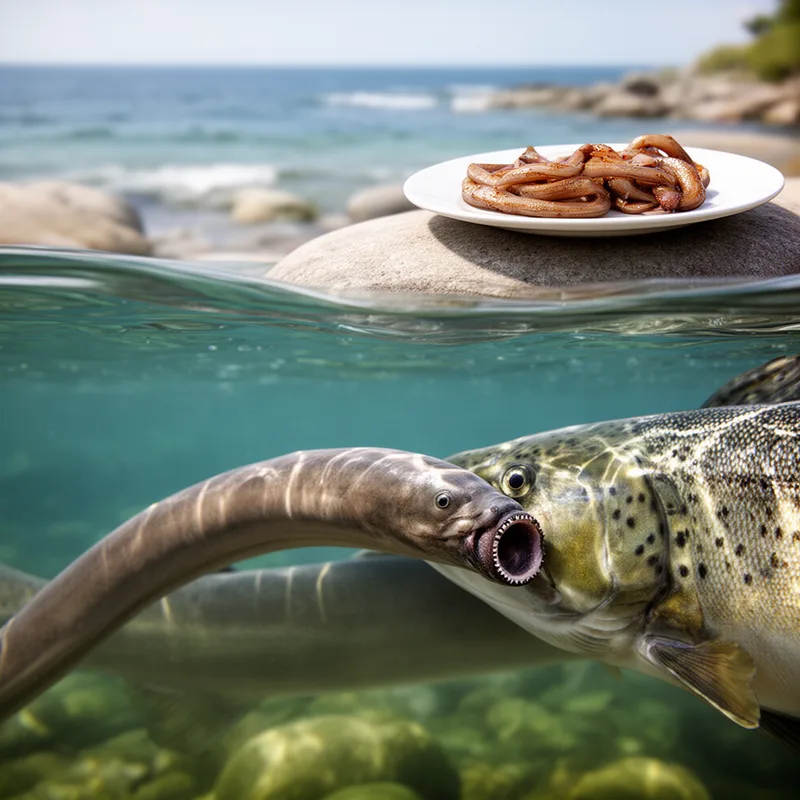
Petromyzon marinus
- noun
- /ˌpɛtrəˈmaɪzən ˈmɛrɪnəs/
- Specialized
- The invasion of Petromyzon marinus drastically altered the fish populations in the Great Lakes.
Examples
-
In some European countries, Petromyzon marinus is considered a delicacy when cooked.
-
Scientists have studied the life cycle of Petromyzon marinus to better control its numbers.
-
The Petromyzon marinus is often found in the Great Lakes.
-
Have you ever seen a Petromyzon marinus in the wild?
-
In some European countries, Petromyzon marinus is considered a delicacy when cooked.
-
The invasion of Petromyzon marinus drastically altered the fish populations in the Great Lakes.
-
Scientists have studied the life cycle of Petromyzon marinus to better control its numbers.
Synonyms


 1
7.5
1
7.5
A large fish without jaws that attaches to other fish and feeds on them
Surface Forms
Morphology
Petromyzon + marinus
The binomial is compositionally analyzable: 'Petromyzon' denotes a jawless fish and 'marinus' (Latin root seen in English 'marine') signals a sea-related form, so a learner who knows both constituents can infer it refers to a marine lamprey. However, the full encyclopedic sense (specific species, anadromous behavior, ecological impact) is technical and not predictable from the parts alone, and 'marinus' is more a learned Latin/derivational element than a common English word, so comprehension is only partial.
Etymology
Petromyzon marinus comes from old words: petro- meaning 'rock' and -myzon meaning 'to suck', plus marinus meaning 'of the sea'. This gives a simple image of a sea lamprey with a round sucking mouth that sticks to fish, so the name fits the animal and helps explain why it can harm other fish.