
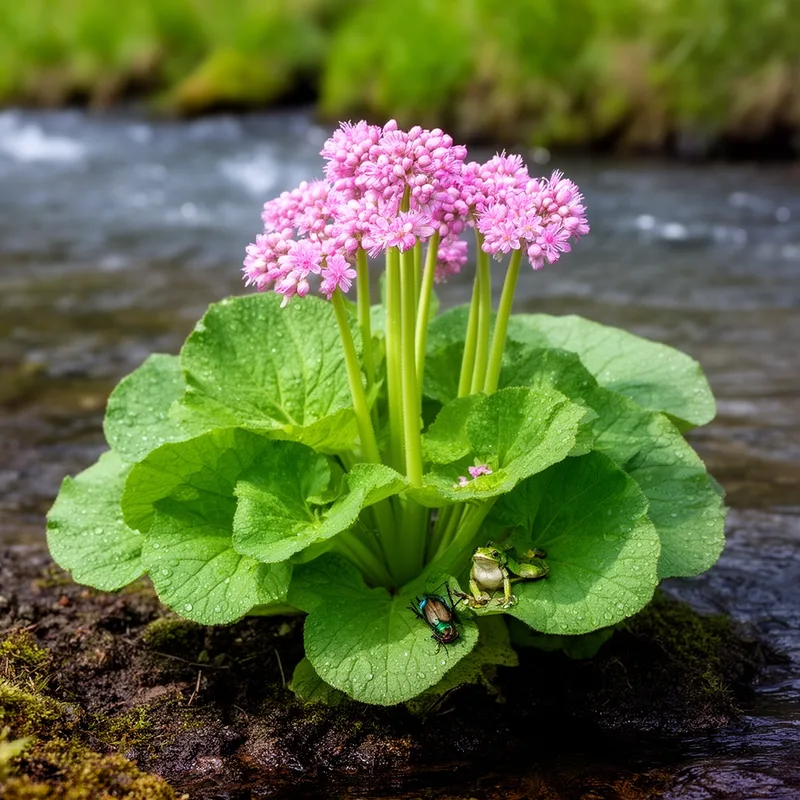
Petasites hybridus
- noun
- Specialized
- You can often find Petasites hybridus growing along riverbanks and in other damp environments.
Examples
-
The large leaves of the Petasites hybridus plant provide shelter for small creatures in wet meadows.
-
Herbalists sometimes use extracts from Petasites hybridus to treat headaches and allergies.
-
The Petasites hybridus grows well near streams.
-
Have you seen the Petasites hybridus blooming this spring?
-
Herbalists sometimes use extracts from Petasites hybridus to treat headaches and allergies.
-
You can often find Petasites hybridus growing along riverbanks and in other damp environments.
-
The large leaves of the Petasites hybridus plant provide shelter for small creatures in wet meadows.
Synonyms
A plant with very large leaves that grows in wet places like riverbanks
A small plant from Europe and Asia with large leaves and pink flowers that grows in wet places

A small plant with broad leaves and pale pink flowers that grows in wet places
Surface Forms
Morphology
Petasites + hybridus
This is a scientific Latin binomial (genus + species) rather than a compositional English phrase; knowing the genus label 'Petasites' and an unclear epithet 'hybridus' does not let a B1 learner infer the descriptive meaning or the common name 'butterbur'. Such taxonomic names function as conventional labels requiring botanical knowledge, so the meaning is not derivable from the parts.
Etymology
Petasites hybridus may come from an old word petasites meaning 'hat', because its large, round leaves look like wide hats or small umbrellas beside streams. That's why this plant, also called 'butterbur', is remembered for its big leaves and for growing in wet places.

