
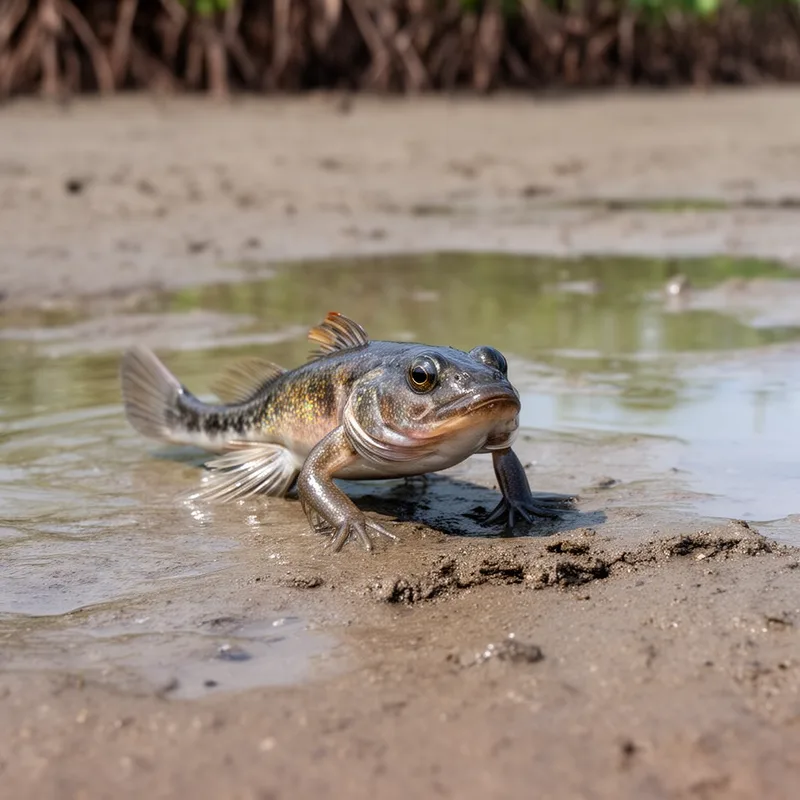
Periophthalmus


 1
9.9
- noun
- Specialized
- Above right: Like other mudskipper species, Periophthalmus climbs easily with leglike fins.
Examples
-
Besides serving as a refuge, a burrow can also be used as a nursery for developing eggs: members of the genera Boleophthalmus and Periophthalmus are known to lay eggs in burrows, and quite possibly this occurs in the other two genera as well.
Academic text (2002) -
On the muddy banks of the river, Periophthalmus can often be seen leaping between puddles during low tide.
-
The local Periophthalmus were busy outside their burrows, decorating the entrances.
Academic text (2002) -
As is the case for Periophthalmus burrows, the water inside those of Scartelaos is low in oxygen, and the fish compensate for this by laying in a supply of air to last through the high tide.
Academic text (2002) -
On the north-central coast of Australia, Periophthalmus minutus build mud turrets at the entrances of their burrows.
Academic text (2002) -
Members of the diverse goby family, the twenty-five mudskipper species, are classified on the basis of body traits and behavior into four genera: Scartelaos, Boleophthalmus, Periophthalmus, and Periophthalmodon.
Academic text (2002) -
The Periophthalmus are fascinating fish that thrive both in water and on land, showcasing their unique adaptability.
-
During a nature walk, we spotted a Periophthalmus resting near its burrow, ready to venture out for food.
Synonyms
 1
9.6
A small tropical fish that uses strong fins to move on land
Surface Forms
Etymology
The word Periophthalmus comes from the parts peri- 'around' and ophthalm- 'eye', the same 'around' in perimeter and the 'eye' in ophthalmology. These mudskipper fish have eyes set high so they can look 'around' while on mud and water, which is why the name fits.