
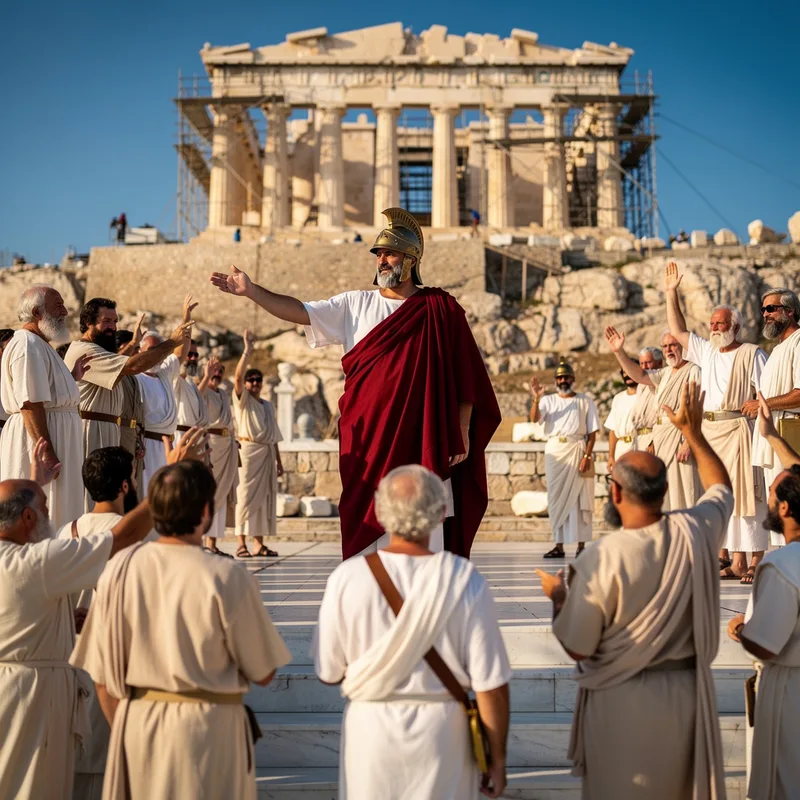
Pericles
 5
8.2

- proper noun
- In the early political ideas of Pericles and Thucydides, Athenian democracy was ranked higher than Sparta's oligarchy, and certainly above tyranny.
- Pericles praises Athens
Loading YouTube…
Watch on YouTubeThey were then in a state of utter hopelessness, and all their angry feelings turned against Pericles.
- They were then in a state of utter hopelessness, and all their angry feelings turned against Pericles.
- Other people might be considered wise in such a sense because they are great statesman like Pericles or particularly good doctors.
Examples
-
The bones of the heroic dead were placed in a public sepulcher, and Pericles, the annually elected military chief, delivered the closing eulogy.
Academic text (2004) -
Thucydides captured this by juxtaposing two speeches by the Athenian statesman Pericles.
Academic text (2004) -
Back in the time of Pericles, what did the winners of the Olympics wear?
-
I would also add the names of Pericles, Lincoln and Churchill.
-
Among the things for which Pericles praises Athens is that it is an open society.
Academic text (1991) -
The trend toward widening the base continued through the age of Pericles, when it included virtually all male citizens.
Academic text (1995) -
Under its great leader, Pericles (461-429 B.C.), Athens reached its height of power and prosperity.
Fiction book (2002) -
Thucydides: Pericles' speech stirs Athenians to fight on, despite many hardships.
Fiction book (2002) -
In ancient Athens, the influential leader Pericles advanced democracy and supported the arts.
-
During the Golden Age of Athens, Pericles commissioned the construction of the iconic Parthenon.
Surface Forms
Etymology
Pericles comes from two Greek parts, peri- meaning 'around' and kleos meaning 'glory'. So the name means 'surrounded by glory', which is easy to remember because Pericles was a famous Athenian leader who led Athens during its Golden Age.