
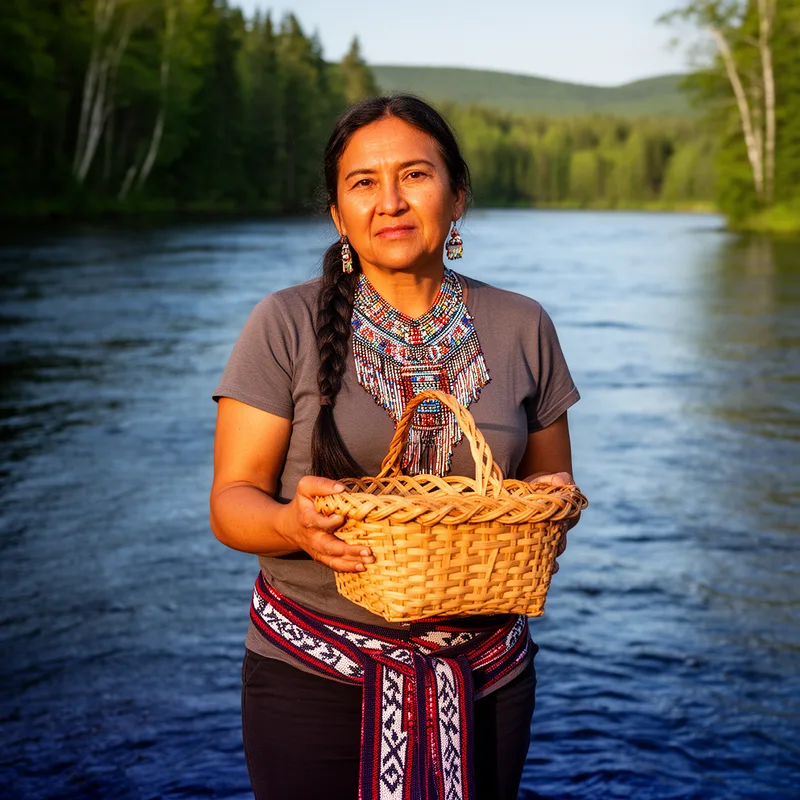
Penobscot


 1
9.9
1
9.9
- proper noun
- /ˈpɛnəbsˌkɒt/
- In most cases, the Indian agent conducted the business agreements or leases on behalf of the Penobscot community.
Loading YouTube…
Watch on YouTubeThe people who spare Pollock, and I live with Penobscot people, place of the White Rocks.
- The people who spare Pollock, and I live with Penobscot people, place of the White Rocks.
Examples
-
The Mi'kmaq, Maliseet, Penobscot, Passamaquoddy, and Abenaki are the constituent nations of the Wabanaki Confederacy.
Academic text (2014) -
In Maine, the Penobscot people work to preserve their language and culture for future generations.
-
In the nineteenth century, the family group or band was the main social unit in Penobscot society.
Academic text (2018) -
In the summer, the Penobscots live by fishing and managing their farms.
Academic text (2018) -
Such was not the case with Louis Francis Sockalexis, the Penobscot from Old Town, Maine.
Academic text (2000) -
However, the significance of Penobscot grandmothers expanded well beyond the inner circles of family life.
Academic text (2018) -
Since landownership was not a traditional concept, Penobscot families struggled with documenting land transfers and the inheritance of lots.
Academic text (2018) -
As island proprietors, Penobscot women, like the men, had to assert their property rights when competing claims surfaced.
Academic text (2018) -
In the 1930s, linguist Frank T. Siebert's fieldwork among the Penobscots revealed the prominence of Indigenous women.
Academic text (2018) -
The Penobscot tribe has a rich cultural heritage that includes unique stories and traditions.
Compounds
A river in central Maine that flows southeast into Penobscot Bay on the Atlantic Ocean
Surface Forms
Etymology
Penobscot also names the Native American people of that river and comes from the same local language, meaning something like 'people of the place where the rocks open'. So the name links the people to the river and the land where they have lived.