
Penicillium
 1
7.8

- noun
- /ˌpɛnɪˈsɪliəm/
- Specialized
- Although Penicillium evolved statins because they blocked cholesterol synthesis in competing microorganisms, statins affect such a basic biological mechanism that they work in humans too.
- Penicillium mold
- species of Penicillium
Examples
-
Penicillium notatum did us a great favor by providing penicillin.
Academic text (2009) -
Alexander Fleming had his penicillium fungi, I have this.
-
Penicillium species have been shown to be fairly common indoors, even in clean environments, but especially in problem buildings.
Academic text (2003) -
They had found that it existed naturally in a Penicillium mold.
Academic text (2009) -
These fungi are often quickly joined by other species, including those in the genera Penicillium and Fusarium.
Academic text (2001) -
At 5°C, cell populations decreased rather steadily over storage time, and Penicillium spp. and --
Academic text (2008) -
Moulds (including Aspergillus, Cladosporium, and Penicillium spp.) were isolated from several covers, but none was contaminated with S. brevicaulis.
Academic text (1995) -
The presence of other non-dermatophytes (particularly Aspergillus and Penicillium species) may be due to the ubiquitous nature of their spores in our environment, carried transiently on healthy skin.
Academic text (2007) -
The principal agents in the compost extracts appear to be bacteria representing, but not necessarily limited to, the genera of Bacillus, Pseudomonas, Serratia, Penicillium, and Trichoderma.
Academic text (1996) -
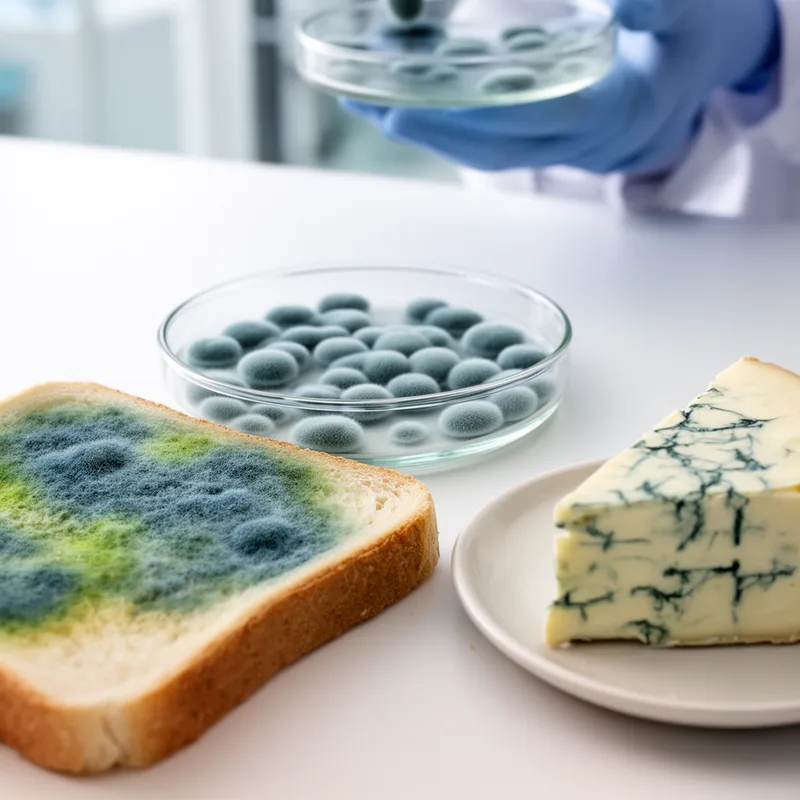
The blue-green mold growing on the old bread is a type of Penicillium that is often found on decaying food.
Surface Forms
Etymology
Penicillium comes from the Latin penicillus, meaning 'little brush', because the mold makes tiny spore clusters that look like small brushes. The same root is in pencil, so imagine a 'little brush' of blue-green mold — these fungi are used in blue cheeses and gave their name to the antibiotic penicillin.