
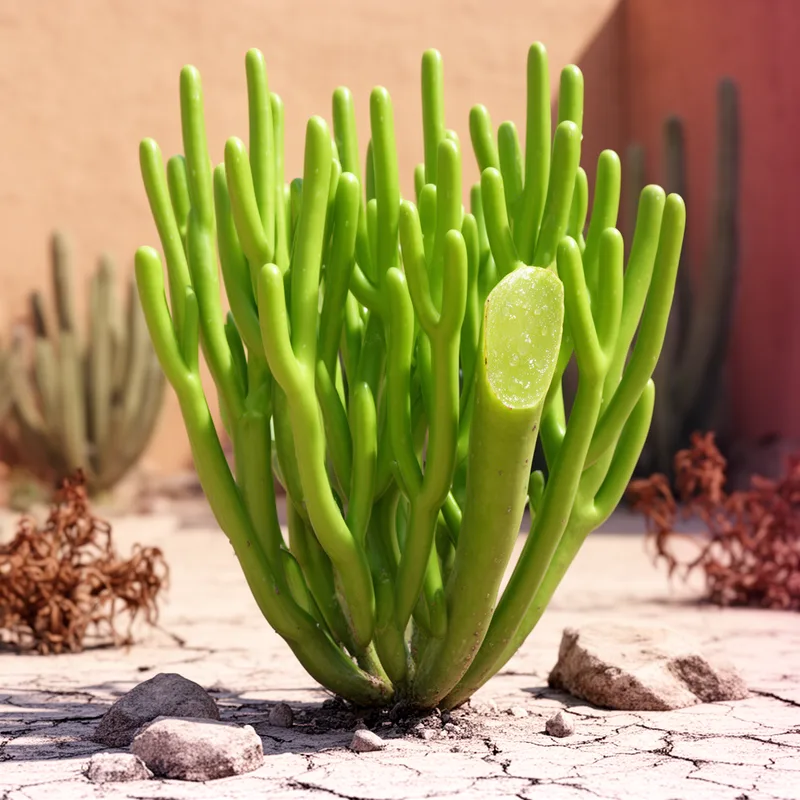
Pedilanthus bracteatus
- noun
- Specialized
- The Pedilanthus bracteatus is often cultivated for its ornamental value and unique waxy stems.
Examples
-
Some traditional practices use the wax from Pedilanthus bracteatus as a natural coating for various items.
-
Gardeners in arid regions sometimes choose Pedilanthus bracteatus because it thrives in dry conditions.
-
The Pedilanthus bracteatus thrives in arid conditions.
-
Many gardeners appreciate the Pedilanthus bracteatus for its unique appearance.
-
Gardeners in arid regions sometimes choose Pedilanthus bracteatus because it thrives in dry conditions.
-
The Pedilanthus bracteatus is often cultivated for its ornamental value and unique waxy stems.
-
Many gardeners appreciate the Pedilanthus bracteatus for its unique appearance.
Surface Forms
Morphology
Pedilanthus + bracteatus
This is a scientific Latin binomial (genus + specific epithet), not a compositional English phrase; the parts are taxonomic labels rather than everyday English words, and 'bracteatus' is not attested in the learner's dictionary. Even if a learner recognized 'Pedilanthus' as a plant genus, the overall meaning ('a wax-coated succulent shrub') cannot be derived from the constituents at B1 level, so it is unpredictable without prior exposure.
Etymology
Pedilanthus bracteatus gets its name from older Greek and Latin words: Pedilanthus means 'slipper flower' because the small blooms look like tiny slippers, and bracteatus means 'with bracts', the leaf-like parts that sit under the flowers. So the name helps you picture the waxy shrub with its slipper-shaped blooms.

