
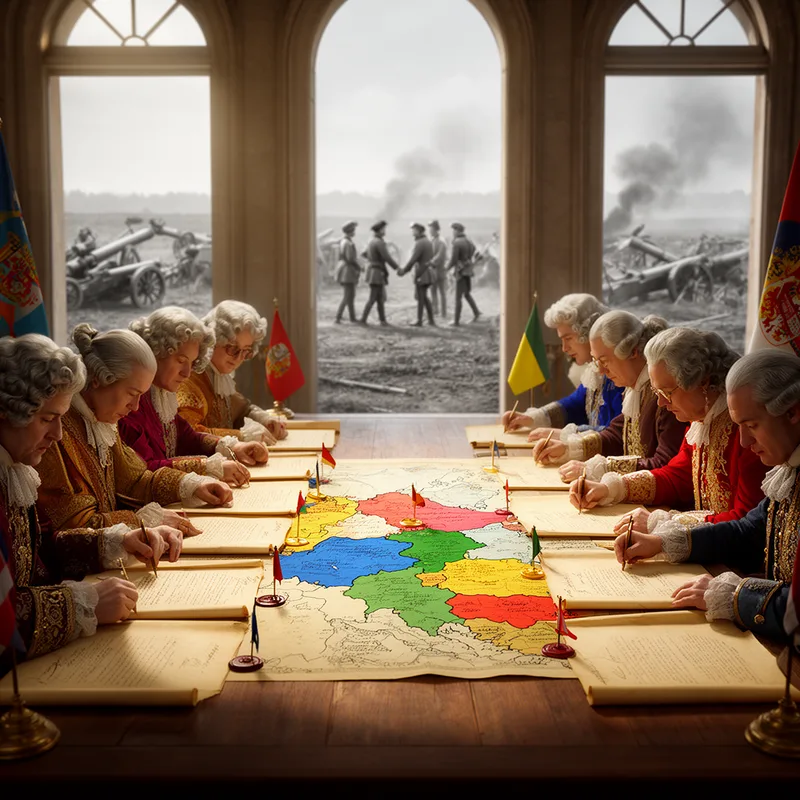
Peace of Westphalia


 1
9.8
1
9.8
- noun
- /piːs əv wɛstˈfeɪliə/
- Formal
- Confirmed in 1648, the Peace of Westphalia ended the devastating Thirty Years' War.
- Peace of Westphalia in 1648
- Peace of Westphalia, which ended
Examples
-
Nationalism, he observes, flourished after the French Revolution, but originated with the Peace of Westphalia when aristocrats used their economic power to influence national governments in order to preserve their wealth and power.
Academic text (2005) -
This is a perfect example of the type of nation-state sovereignty that the Peace of Westphalia hoped to achieve.
Academic text (2005) -
Yet, the Peace of Westphalia remains the foundation of modern international relations.
Academic text (2005) -
The Papacy also lost much of its political power following the Peace of Westphalia.
Academic text (2005) -
The emergence of this European public order is probably as important for the future of a democratic Europe as the Peace of Westphalia was for religious tolerance.
Academic text (1990) -
Be that as it may, state sovereignty came to be accepted as a principle of international law at the Peace of Westphalia, ending the Thirty Years' War in 1648.
Academic text (1994) -
Prior to the Peace of Westphalia, most polities in Europe were ruled by an emperor, a leading clergyman, or a feudal lord.
Academic text (2005) -
War in 1648, the Peace of Westphalia is often viewed as the progenitor of modern nation-state sovereignty.
Academic text (2005) -
The Peace of Westphalia, however, damaged the Papacy by extending the Peace of Augsburg to recognize Calvinism.
Academic text (2005) -
Coinciding in part with the Protestant Reformation, the Peace of Westphalia further weakened Papal authority throughout much of Europe.
Academic text (2005)
Synonyms
 1
9.8
1
9.8
A set of treaties in 1648 that ended the Thirty Years' War and set rules for independent countries
Surface Forms
Morphology
peace + of + Westphalia
A learner who knows 'peace' and the place-name 'Westphalia' can infer this is a peace agreement associated with Westphalia (naming-after-place is cross-linguistically common), so the basic referent (a treaty or peace) is recoverable. However, the specific historical sense — that it is a series of 1648 treaties that created a new political order and sovereignty principles — is not derivable from the constituents, so the expression is only partially transparent.
Etymology
The Peace of Westphalia was a set of agreements signed in 1648 in towns in the Westphalia region where rulers agreed to end a long war. Because the agreements said each ruler should 'control their own land' and not let other rulers get involved, the name now stands for the idea of modern countries and their right to be independent.