
Pavlov
 5
5.2

- proper noun
- /ˈpæv.lɒv/
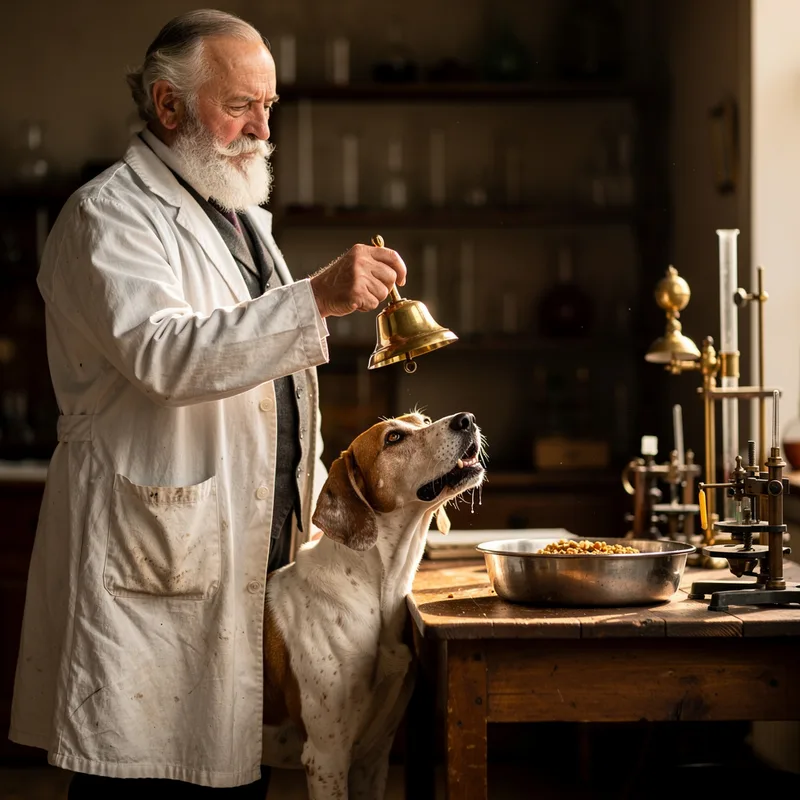
- I mean, it's like Pavlov’s dog: The bell rings, and he salivates.
- Ivan Pavlov
Loading YouTube…
Watch on YouTubeWhat you do is you, you get this warm bread and like Pavlov's dog, your mouth starts whining.
- What you do is you, you get this warm bread and like Pavlov's dog, your mouth starts whining.
- And it has to do with, well, Pavlov's dog.
- And now it's I love that you just said the Pavlov's dog thing because that's exactly what it is.
- One is Ivan Pavlov, where he said if you want a new idea, read an old book.
- We all know about conditioning because Pavlov taught us that if you show a dog, have him hear a sound when they get me.
- I mean, I'm literally salivating like Pavlov's dog walk to the coffee maker to make said cup of coffee and then I realize I forgot to buy coffee.
- And you've probably all heard of Pavlov or Watson.
- I'd say, OK, the whole goal, this is where it's Pavlov's dog.
- And this Lenin said Lenin was a big fan of Pavlov even at a time.
- That's unique because that that's like, does Pavlov ring a bell?
Examples
-
Russian physiologist Ivan Pavlov is known for his groundbreaking research on conditioned reflexes through experiments with dogs.
-
We all know about conditioning because Pavlov taught us that if you show a dog, have him hear a sound when they get me.
-
We were worked on for three days by a team of specialists from the Pavlov Institute in Moscow.
-
The dog brain is more complex still, and dogs were used by Ivan Pavlov in his experiments on classical conditioning.
Academic text (2010) -
Think of Pavlov and his dogs or Goodall and her chimps.
Blog text (30) -
The experiments conducted by Ivan Pavlov laid the foundation for the field of psychology, particularly in understanding behavior.
-
In psychology classes, students often learn about Ivan Pavlov and his famous experiments with the salivating dogs.
Surface Forms
Etymology
Pavlov comes from the Russian name Pavel, which is like 'Paul', plus the ending -ov that means 'son of'. It is the family name of Ivan Pavlov, the scientist famous for experiments where dogs learned to react to bells, so Pavlov now reminds us of 'learned responses'.