
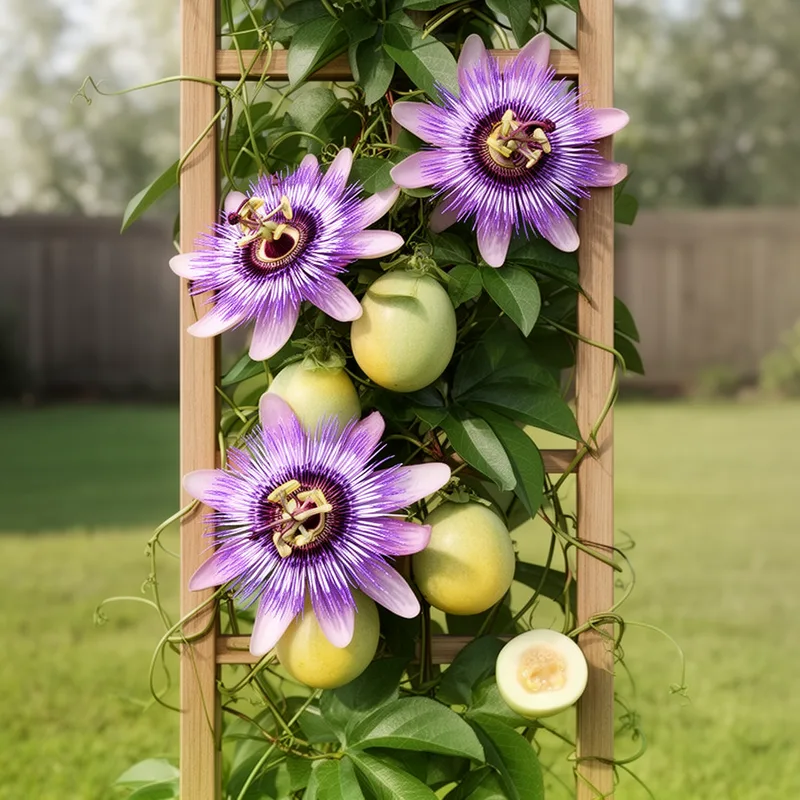
Passiflora incarnata
- noun
- /ˌpæsɪˈflɔːrə ɪnˈkɑrnəˌtɑ/
- Specialized
- The fruit of the Passiflora incarnata vine is often called a maypop in the southern United States.
Examples
-
Some herbal teas use dried leaves from the Passiflora incarnata plant for their calming effects.
-
Gardeners appreciate Passiflora incarnata for its beautiful purple flowers and rapid growth.
-
The Passiflora incarnata is often found in warm, sunny areas.
-
Many gardeners enjoy planting Passiflora incarnata for its beautiful flowers.
-
Many gardeners cultivate Passiflora incarnata due to its attractive flowers and unique appearance.
-
The Passiflora incarnata plant thrives in warm climates and produces striking blooms.
-
In the southern United States, Passiflora incarnata is recognized for its large, edible fruits called maypops.
Synonyms

A climbing plant with large flowers and egg-shaped fruit
Surface Forms
Morphology
Passiflora + incarnata
This is a Linnaean binomial: 'Passiflora' clearly identifies the genus (passionflower), so learners can infer it names a particular kind of passionflower. However, 'incarnata' is a Latin specific epithet whose descriptive sense and the species' particular traits are not derivable by an average B1 learner, so the meaning is only partially transparent.
Etymology
Passiflora incarnata gets its name from the 'passion flower' idea: early Christian visitors thought the flower's many threads and shapes looked like the crown of thorns and other tools of Christ's suffering. The first part, Passiflora, refers to that 'passion flower' image, and the second part, incarnata, comes from a Latin word meaning 'flesh-coloured' or 'pink', so the full name points to a passion-themed flower with pale pink-purple colours.

