

Paspalum notatum
- noun
- Specialized
- Paspalum notatum is widely planted as a drought-resistant pasture grass in the southeastern United States.
Examples
-
Farmers often choose Paspalum notatum for grazing livestock in sandy, nutrient-poor soils.
-
The deep roots of Paspalum notatum help prevent soil erosion in pasture lands.
-
Farmers often use Paspalum notatum for grazing.
-
Paspalum notatum thrives in warm climates.
-
Paspalum notatum is a popular choice for pasture grass due to its drought resistance and ability to thrive in arid conditions.
-
Many ranchers cultivate Paspalum notatum because it provides lush grazing for livestock in the Gulf States.
-
With its extensive root system, Paspalum notatum is effective at stabilizing soil and preventing erosion in dry landscapes.
Synonyms
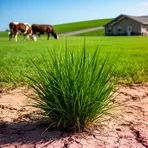
A tough grass used for pasture and lawns in warm dry places
Surface Forms
Morphology
Paspalum + notatum
The form is a Linnaean binomial: 'Paspalum' names a genus of grasses, so a learner who knows that constituent could infer this is a type of grass. However 'notatum' is not a productive English word here (it functions as a species epithet/proper name) and the specific sense 'bahiagrass' cannot be derived from the parts alone, so the relation is only partially transparent.
Etymology
Paspalum notatum may come from old words for warm-country grasses combined with Latin. Paspalum was a name for tropical or summer grasses, and notatum means 'marked' in Latin. So the name gives an easy picture, a tropical grass with a visible mark, and that helps you remember this grass that resists dry weather.

