
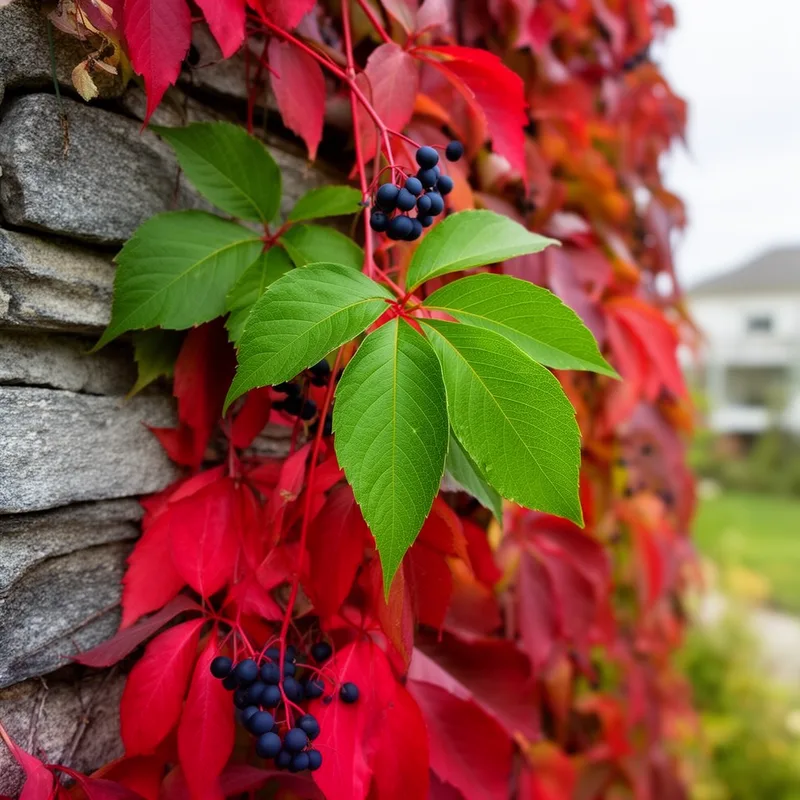
Parthenocissus quinquefolia
- noun
- /ˌpɑrθəˈnoʊsɪs kwɪnkwəˈfoʊliə/
- Specialized
- Gardeners value Parthenocissus quinquefolia for its brilliant red foliage in autumn.
Examples
-
The Parthenocissus quinquefolia quickly covered the old stone wall in just a few years.
-
Birds are attracted to the berries produced by Parthenocissus quinquefolia.
-
The Parthenocissus quinquefolia grows rapidly in the summer.
-
Many gardeners love the Parthenocissus quinquefolia for its lush green leaves.
-
Birds are attracted to the berries produced by Parthenocissus quinquefolia.
-
Gardeners value Parthenocissus quinquefolia for its brilliant red foliage in autumn.
-
The Parthenocissus quinquefolia quickly covered the old stone wall in just a few years.
Synonyms


 1
5.4
1
5.4
A climbing plant with five leaflets on each stem and dark berries
 1
9.9
1
9.9
A climbing vine with many small leaves on each stem and blue-black berries

A climbing plant with compound leaves and dark berries
Surface Forms
Morphology
Parthenocissus + quinquefolia
This is a scientific Latin binomial (genus + specific epithet) used as a taxonomic label rather than a compositional English phrase; its referent 'Virginia creeper' is not predictable from ordinary English knowledge. A B1 learner—even if they recognised 'Parthenocissus' as a genus—would not be able to infer the common name or full meaning from the Latin elements (and 'quinquefolia' is not a common English word), so the expression is effectively idiomatic/technical for learners.
Etymology
Parthenocissus quinquefolia literally describes the vine: Parthenocissus comes from Greek for 'virgin ivy' and quinquefolia means 'five leaves'. So the name is a memory hint that points to the climbing plant called 'Virginia creeper', which has leaves split into five parts and small dark berries.